Week 4: Batch loading data & list columns

Author
Affiliation

Joe Nese

University of Oregon
Spring 2026

NEED TO GET DATA/SIM FROM COURSE REPO TO FOLLOW ALONG

remove purrr::compose()

explain dplyr::nest_by() better

Batch Load Data & List Columns

Week 4

Agenda

  • Review Lab 2
  • map_dfr
  • List columns
  • Batch-loading data
  • Midterm Student Survey

Learning objectives

  • Understand when map_dfr can and should be applied
  • Better understand file paths, and how {fs} can help
  • Be able to batch load data of a specific type within a mixed-type directory
  • Use file names to pull data
  • Introduce list columns
  • Contrast:
    • group_by() |> nest() |> mutate() |> map() with
    • nest_by() |> summarize()
  • Understand list columns and how they relate to base::split
  • Fluently nest/unnest data frames
  • Understand why tidyr::nest() can be a powerful framework (data frames) and when tidyr::unnest() can/should be used to move out of nested data frames and into a standard data frame

Review Lab 2

map_dfr()

map_dfr()

If each iteration returns a data frame, you can use map_dfr to automatically bind all the data frames together

Example

Create a function that simulates data (please copy the code and follow along)

set.seed(3000)
simulate <- function(n, mean = 0, sd = 1) {
    tibble(sample_id = seq_len(n),
           sample = rnorm(n, mean, sd))
}
simulate(10)
# A tibble: 10 × 2
   sample_id sample
       <int>  <dbl>
 1         1  1.26 
 2         2  0.645
 3         3  0.463
 4         4  0.770
 5         5 -0.226
 6         6 -0.352
 7         7 -0.649
 8         8 -1.26 
 9         9 -1.70 
10        10 -1.83 

Two more quick examples

simulate(3, 100, 10)
# A tibble: 3 × 2
  sample_id sample
      <int>  <dbl>
1         1   91.8
2         2   83.8
3         3  103. 
simulate(5, -10, 1.5)
# A tibble: 5 × 2
  sample_id sample
      <int>  <dbl>
1         1  -7.76
2         2  -9.96
3         3 -10.8 
4         4  -9.32
5         5  -9.10

Simulation

  • Assume we want to vary the sample size from 10 to 150 by increments of 5
  • mean stays constant at 100
  • sd is constant at 10

Try with purrr::map()

library(tidyverse)
sims <- map(seq(10, 150, 5), simulate, mean = 100, sd = 10)
sims[1]
[[1]]
# A tibble: 10 × 2
   sample_id sample
       <int>  <dbl>
 1         1  111. 
 2         2   80.4
 3         3   99.5
 4         4  110. 
 5         5   93.5
 6         6   95.4
 7         7   89.7
 8         8   92.7
 9         9  106. 
10        10   94.4
sims[2]
[[1]]
# A tibble: 15 × 2
   sample_id sample
       <int>  <dbl>
 1         1   87.4
 2         2   93.7
 3         3   96.6
 4         4  104. 
 5         5  110. 
 6         6   91.6
 7         7  110. 
 8         8   99.7
 9         9   96.5
10        10   99.2
11        11   77.5
12        12  108. 
13        13   75.2
14        14  113. 
15        15  105. 

Swap for map_dfr

Try it - what happens?

. . .

sims_df <- map_dfr(seq(10, 150, 5), simulate, 100, 10)
sims_df
# A tibble: 2,320 × 2
   sample_id sample
       <int>  <dbl>
 1         1   93.6
 2         2  108. 
 3         3  107. 
 4         4   92.6
 5         5  112. 
 6         6   90.6
 7         7  107. 
 8         8  117. 
 9         9  106. 
10        10   99.2
# ℹ 2,310 more rows

Notice a problem here?

sims_df[1:26, ]
# A tibble: 26 × 2
   sample_id sample
       <int>  <dbl>
 1         1   93.6
 2         2  108. 
 3         3  107. 
 4         4   92.6
 5         5  112. 
 6         6   90.6
 7         7  107. 
 8         8  117. 
 9         9  106. 
10        10   99.2
# ℹ 16 more rows

.id

Either a string or NULL

  • If a string, the output will contain a variable with that name, storing either the name (if .x is named) or the index (if .x is unnamed) of the input.
  • If NULL, the default, no variable will be created.

.id string unnamed

sims_df2 <- map_dfr(seq(10, 150, 5), simulate, 100, 10, 
                   .id = "iteration")
sims_df2[1:15, ]
# A tibble: 15 × 3
   iteration sample_id sample
   <chr>         <int>  <dbl>
 1 1                 1  100. 
 2 1                 2  108. 
 3 1                 3   98.9
 4 1                 4  106. 
 5 1                 5  103. 
 6 1                 6  119. 
 7 1                 7  109. 
 8 1                 8  116. 
 9 1                 9  102. 
10 1                10   82.9
11 2                 1   86.0
12 2                 2   98.1
13 2                 3  126. 
14 2                 4   95.4
15 2                 5  102. 

.id named string

setNames()

  • sets the names on an object and returns the object

setNames(object = nm, nm)

  • nm = a character vector of names to assign to the object

. . .

sample_size <- setNames(seq(10, 150, 5), 
                        english::english(seq(10, 150, 5))) 
sample_size[1:15]
         ten      fifteen       twenty  twenty-five       thirty  thirty-five 
          10           15           20           25           30           35 
       forty   forty-five        fifty   fifty-five        sixty   sixty-five 
          40           45           50           55           60           65 
     seventy seventy-five       eighty 
          70           75           80 

Try again

sims_df3 <- map_dfr(sample_size, simulate, 100, 10, 
                   .id = "n")
sims_df3[1:15, ]
# A tibble: 15 × 3
   n       sample_id sample
   <chr>       <int>  <dbl>
 1 ten             1   99.7
 2 ten             2  109. 
 3 ten             3  119. 
 4 ten             4   97.9
 5 ten             5   99.9
 6 ten             6  101. 
 7 ten             7   80.5
 8 ten             8   98.3
 9 ten             9  101. 
10 ten            10   96.7
11 fifteen         1   98.0
12 fifteen         2   93.2
13 fifteen         3  102. 
14 fifteen         4  101. 
15 fifteen         5  103. 

broom::tidy()

The {broom} package helps us extract model output in a tidy format

lm(tvhours ~ age, gss_cat) |>
    broom::tidy()
# A tibble: 2 × 5
  term        estimate std.error statistic   p.value
  <chr>          <dbl>     <dbl>     <dbl>     <dbl>
1 (Intercept)   1.99     0.0698       28.5 4.67e-173
2 age           0.0210   0.00139      15.1 4.69e- 51

Fit separate models by year

Again - probably not the best statistically

split(gss_cat, gss_cat$year) |>
 map_dfr(
   ~lm(tvhours ~ age, .x) |>
     broom::tidy()
) 
# A tibble: 16 × 5
   term        estimate std.error statistic  p.value
   <chr>          <dbl>     <dbl>     <dbl>    <dbl>
 1 (Intercept)   2.08     0.171       12.2  8.00e-33
 2 age           0.0195   0.00349      5.59 2.60e- 8
 3 (Intercept)   2.08     0.218        9.55 1.19e-20
 4 age           0.0196   0.00440      4.46 9.14e- 6
 5 (Intercept)   1.77     0.246        7.17 1.53e-12
 6 age           0.0239   0.00503      4.74 2.46e- 6
 7 (Intercept)   2.10     0.150       14.0  1.42e-42
 8 age           0.0178   0.00298      5.98 2.59e- 9
 9 (Intercept)   1.86     0.216        8.60 2.17e-17
10 age           0.0239   0.00431      5.54 3.63e- 8
11 (Intercept)   2.07     0.210        9.87 2.90e-22
12 age           0.0199   0.00409      4.87 1.25e- 6
13 (Intercept)   1.88     0.226        8.32 2.28e-16
14 age           0.0255   0.00445      5.73 1.27e- 8
15 (Intercept)   1.98     0.188       10.5  3.24e-25
16 age           0.0205   0.00361      5.67 1.65e- 8

Add .id

In cases like the preceding, .id becomes invaluable

split(gss_cat, gss_cat$year) |>
 map_dfr(
   ~lm(tvhours ~ age, .x) |>
     broom::tidy(),
   .id = "year"
) 
# A tibble: 16 × 6
   year  term        estimate std.error statistic  p.value
   <chr> <chr>          <dbl>     <dbl>     <dbl>    <dbl>
 1 2000  (Intercept)   2.08     0.171       12.2  8.00e-33
 2 2000  age           0.0195   0.00349      5.59 2.60e- 8
 3 2002  (Intercept)   2.08     0.218        9.55 1.19e-20
 4 2002  age           0.0196   0.00440      4.46 9.14e- 6
 5 2004  (Intercept)   1.77     0.246        7.17 1.53e-12
 6 2004  age           0.0239   0.00503      4.74 2.46e- 6
 7 2006  (Intercept)   2.10     0.150       14.0  1.42e-42
 8 2006  age           0.0178   0.00298      5.98 2.59e- 9
 9 2008  (Intercept)   1.86     0.216        8.60 2.17e-17
10 2008  age           0.0239   0.00431      5.54 3.63e- 8
11 2010  (Intercept)   2.07     0.210        9.87 2.90e-22
12 2010  age           0.0199   0.00409      4.87 1.25e- 6
13 2012  (Intercept)   1.88     0.226        8.32 2.28e-16
14 2012  age           0.0255   0.00445      5.73 1.27e- 8
15 2014  (Intercept)   1.98     0.188       10.5  3.24e-25
16 2014  age           0.0205   0.00361      5.67 1.65e- 8

Batch-loading data

Please follow along

{fs} functions

  • {fs} functions always return ‘tidy’ paths
  • {fs} functions divided into four main categories:
    • path_: manipulating and constructing paths
    • file_: files
    • dir_: directories
    • link_: links

{fs}

Could we apply map_dfr here?

# install.packages("fs")
library(fs)
dir_ls(here::here("data"))
C:/Users/jnese/Desktop/BRT/Teaching/3_Functional-Programming/functional-programming_spring-2026/data/benchmarks.csv
C:/Users/jnese/Desktop/BRT/Teaching/3_Functional-Programming/functional-programming_spring-2026/data/insurance_coverage.csv
C:/Users/jnese/Desktop/BRT/Teaching/3_Functional-Programming/functional-programming_spring-2026/data/pfiles_sim
C:/Users/jnese/Desktop/BRT/Teaching/3_Functional-Programming/functional-programming_spring-2026/data/question_2

. . .

dir_ls(here::here("data", "pfiles_sim"))
C:/Users/jnese/Desktop/BRT/Teaching/3_Functional-Programming/functional-programming_spring-2026/data/pfiles_sim/g11ELApfiles18_sim.csv
C:/Users/jnese/Desktop/BRT/Teaching/3_Functional-Programming/functional-programming_spring-2026/data/pfiles_sim/g11Mathpfiles18_sim.csv
C:/Users/jnese/Desktop/BRT/Teaching/3_Functional-Programming/functional-programming_spring-2026/data/pfiles_sim/g11Rdgpfiles18_sim.csv
C:/Users/jnese/Desktop/BRT/Teaching/3_Functional-Programming/functional-programming_spring-2026/data/pfiles_sim/g11Sciencepfiles18_sim.csv
C:/Users/jnese/Desktop/BRT/Teaching/3_Functional-Programming/functional-programming_spring-2026/data/pfiles_sim/g11Wripfiles18_sim.csv
C:/Users/jnese/Desktop/BRT/Teaching/3_Functional-Programming/functional-programming_spring-2026/data/pfiles_sim/g3ELApfiles18_sim.csv
C:/Users/jnese/Desktop/BRT/Teaching/3_Functional-Programming/functional-programming_spring-2026/data/pfiles_sim/g3Mathpfiles18_sim.csv
C:/Users/jnese/Desktop/BRT/Teaching/3_Functional-Programming/functional-programming_spring-2026/data/pfiles_sim/g3Rdgpfiles18_sim.csv
C:/Users/jnese/Desktop/BRT/Teaching/3_Functional-Programming/functional-programming_spring-2026/data/pfiles_sim/g3Wripfiles18_sim.csv
C:/Users/jnese/Desktop/BRT/Teaching/3_Functional-Programming/functional-programming_spring-2026/data/pfiles_sim/g4ELApfiles18_sim.csv
C:/Users/jnese/Desktop/BRT/Teaching/3_Functional-Programming/functional-programming_spring-2026/data/pfiles_sim/g4Mathpfiles18_sim.csv
C:/Users/jnese/Desktop/BRT/Teaching/3_Functional-Programming/functional-programming_spring-2026/data/pfiles_sim/g4Rdgpfiles18_sim.csv
C:/Users/jnese/Desktop/BRT/Teaching/3_Functional-Programming/functional-programming_spring-2026/data/pfiles_sim/g4Wripfiles18_sim.csv
C:/Users/jnese/Desktop/BRT/Teaching/3_Functional-Programming/functional-programming_spring-2026/data/pfiles_sim/g5ELApfiles18_sim.csv
C:/Users/jnese/Desktop/BRT/Teaching/3_Functional-Programming/functional-programming_spring-2026/data/pfiles_sim/g5Mathpfiles18_sim.csv
C:/Users/jnese/Desktop/BRT/Teaching/3_Functional-Programming/functional-programming_spring-2026/data/pfiles_sim/g5Rdgpfiles18_sim.csv
C:/Users/jnese/Desktop/BRT/Teaching/3_Functional-Programming/functional-programming_spring-2026/data/pfiles_sim/g5Sciencepfiles18_sim.csv
C:/Users/jnese/Desktop/BRT/Teaching/3_Functional-Programming/functional-programming_spring-2026/data/pfiles_sim/g5Wripfiles18_sim.csv
C:/Users/jnese/Desktop/BRT/Teaching/3_Functional-Programming/functional-programming_spring-2026/data/pfiles_sim/g6ELApfiles18_sim.csv
C:/Users/jnese/Desktop/BRT/Teaching/3_Functional-Programming/functional-programming_spring-2026/data/pfiles_sim/g6Mathpfiles18_sim.csv
C:/Users/jnese/Desktop/BRT/Teaching/3_Functional-Programming/functional-programming_spring-2026/data/pfiles_sim/g6Rdgpfiles18_sim.csv
C:/Users/jnese/Desktop/BRT/Teaching/3_Functional-Programming/functional-programming_spring-2026/data/pfiles_sim/g6Wripfiles18_sim.csv
C:/Users/jnese/Desktop/BRT/Teaching/3_Functional-Programming/functional-programming_spring-2026/data/pfiles_sim/g7ELApfiles18_sim.csv
C:/Users/jnese/Desktop/BRT/Teaching/3_Functional-Programming/functional-programming_spring-2026/data/pfiles_sim/g7Mathpfiles18_sim.csv
C:/Users/jnese/Desktop/BRT/Teaching/3_Functional-Programming/functional-programming_spring-2026/data/pfiles_sim/g7Rdgpfiles18_sim.csv
C:/Users/jnese/Desktop/BRT/Teaching/3_Functional-Programming/functional-programming_spring-2026/data/pfiles_sim/g7Wripfiles18_sim.csv
C:/Users/jnese/Desktop/BRT/Teaching/3_Functional-Programming/functional-programming_spring-2026/data/pfiles_sim/g8ELApfiles18_sim.csv
C:/Users/jnese/Desktop/BRT/Teaching/3_Functional-Programming/functional-programming_spring-2026/data/pfiles_sim/g8Mathpfiles18_sim.csv
C:/Users/jnese/Desktop/BRT/Teaching/3_Functional-Programming/functional-programming_spring-2026/data/pfiles_sim/g8Rdgpfiles18_sim.csv
C:/Users/jnese/Desktop/BRT/Teaching/3_Functional-Programming/functional-programming_spring-2026/data/pfiles_sim/g8Sciencepfiles18_sim.csv
C:/Users/jnese/Desktop/BRT/Teaching/3_Functional-Programming/functional-programming_spring-2026/data/pfiles_sim/g8Wripfiles18_sim.csv

Limit files

  • To be specific, we only want the .csvfiles
  • That happens to be the only thing that’s in there but that’s not regularly the case
dir_ls(here::here("data", "pfiles_sim"), glob = "*.csv")
C:/Users/jnese/Desktop/BRT/Teaching/3_Functional-Programming/functional-programming_spring-2026/data/pfiles_sim/g11ELApfiles18_sim.csv
C:/Users/jnese/Desktop/BRT/Teaching/3_Functional-Programming/functional-programming_spring-2026/data/pfiles_sim/g11Mathpfiles18_sim.csv
C:/Users/jnese/Desktop/BRT/Teaching/3_Functional-Programming/functional-programming_spring-2026/data/pfiles_sim/g11Rdgpfiles18_sim.csv
C:/Users/jnese/Desktop/BRT/Teaching/3_Functional-Programming/functional-programming_spring-2026/data/pfiles_sim/g11Sciencepfiles18_sim.csv
C:/Users/jnese/Desktop/BRT/Teaching/3_Functional-Programming/functional-programming_spring-2026/data/pfiles_sim/g11Wripfiles18_sim.csv
C:/Users/jnese/Desktop/BRT/Teaching/3_Functional-Programming/functional-programming_spring-2026/data/pfiles_sim/g3ELApfiles18_sim.csv
C:/Users/jnese/Desktop/BRT/Teaching/3_Functional-Programming/functional-programming_spring-2026/data/pfiles_sim/g3Mathpfiles18_sim.csv
C:/Users/jnese/Desktop/BRT/Teaching/3_Functional-Programming/functional-programming_spring-2026/data/pfiles_sim/g3Rdgpfiles18_sim.csv
C:/Users/jnese/Desktop/BRT/Teaching/3_Functional-Programming/functional-programming_spring-2026/data/pfiles_sim/g3Wripfiles18_sim.csv
C:/Users/jnese/Desktop/BRT/Teaching/3_Functional-Programming/functional-programming_spring-2026/data/pfiles_sim/g4ELApfiles18_sim.csv
C:/Users/jnese/Desktop/BRT/Teaching/3_Functional-Programming/functional-programming_spring-2026/data/pfiles_sim/g4Mathpfiles18_sim.csv
C:/Users/jnese/Desktop/BRT/Teaching/3_Functional-Programming/functional-programming_spring-2026/data/pfiles_sim/g4Rdgpfiles18_sim.csv
C:/Users/jnese/Desktop/BRT/Teaching/3_Functional-Programming/functional-programming_spring-2026/data/pfiles_sim/g4Wripfiles18_sim.csv
C:/Users/jnese/Desktop/BRT/Teaching/3_Functional-Programming/functional-programming_spring-2026/data/pfiles_sim/g5ELApfiles18_sim.csv
C:/Users/jnese/Desktop/BRT/Teaching/3_Functional-Programming/functional-programming_spring-2026/data/pfiles_sim/g5Mathpfiles18_sim.csv
C:/Users/jnese/Desktop/BRT/Teaching/3_Functional-Programming/functional-programming_spring-2026/data/pfiles_sim/g5Rdgpfiles18_sim.csv
C:/Users/jnese/Desktop/BRT/Teaching/3_Functional-Programming/functional-programming_spring-2026/data/pfiles_sim/g5Sciencepfiles18_sim.csv
C:/Users/jnese/Desktop/BRT/Teaching/3_Functional-Programming/functional-programming_spring-2026/data/pfiles_sim/g5Wripfiles18_sim.csv
C:/Users/jnese/Desktop/BRT/Teaching/3_Functional-Programming/functional-programming_spring-2026/data/pfiles_sim/g6ELApfiles18_sim.csv
C:/Users/jnese/Desktop/BRT/Teaching/3_Functional-Programming/functional-programming_spring-2026/data/pfiles_sim/g6Mathpfiles18_sim.csv
C:/Users/jnese/Desktop/BRT/Teaching/3_Functional-Programming/functional-programming_spring-2026/data/pfiles_sim/g6Rdgpfiles18_sim.csv
C:/Users/jnese/Desktop/BRT/Teaching/3_Functional-Programming/functional-programming_spring-2026/data/pfiles_sim/g6Wripfiles18_sim.csv
C:/Users/jnese/Desktop/BRT/Teaching/3_Functional-Programming/functional-programming_spring-2026/data/pfiles_sim/g7ELApfiles18_sim.csv
C:/Users/jnese/Desktop/BRT/Teaching/3_Functional-Programming/functional-programming_spring-2026/data/pfiles_sim/g7Mathpfiles18_sim.csv
C:/Users/jnese/Desktop/BRT/Teaching/3_Functional-Programming/functional-programming_spring-2026/data/pfiles_sim/g7Rdgpfiles18_sim.csv
C:/Users/jnese/Desktop/BRT/Teaching/3_Functional-Programming/functional-programming_spring-2026/data/pfiles_sim/g7Wripfiles18_sim.csv
C:/Users/jnese/Desktop/BRT/Teaching/3_Functional-Programming/functional-programming_spring-2026/data/pfiles_sim/g8ELApfiles18_sim.csv
C:/Users/jnese/Desktop/BRT/Teaching/3_Functional-Programming/functional-programming_spring-2026/data/pfiles_sim/g8Mathpfiles18_sim.csv
C:/Users/jnese/Desktop/BRT/Teaching/3_Functional-Programming/functional-programming_spring-2026/data/pfiles_sim/g8Rdgpfiles18_sim.csv
C:/Users/jnese/Desktop/BRT/Teaching/3_Functional-Programming/functional-programming_spring-2026/data/pfiles_sim/g8Sciencepfiles18_sim.csv
C:/Users/jnese/Desktop/BRT/Teaching/3_Functional-Programming/functional-programming_spring-2026/data/pfiles_sim/g8Wripfiles18_sim.csv

Batch load

Loop through the directories and import() or read_csv()

files <- dir_ls(
  here::here("data", "pfiles_sim"), 
  glob = "*.csv"
)
batch <- map_dfr(files, read_csv)
batch
# A tibble: 15,945 × 22
   Entry  Theta Status Count RawScore    SE Infit Infit_Z Outfit Outfit_Z
   <dbl>  <dbl>  <dbl> <dbl>    <dbl> <dbl> <dbl>   <dbl>  <dbl>    <dbl>
 1   123  1.27       1    36       23 0.371  0.93   -0.34   0.82    -0.62
 2    88  1.55       1    36       25 0.385  0.95   -0.37   0.81    -0.56
 3   105  3.28       1    36       33 0.619  0.9    -0.04   1.63     1.03
 4   153  4.48       1    36       35 1.02   0.93    0.23   0.35    -0.16
 5   437  2.67       1    36       31 0.501  0.92   -0.18   0.88    -0.12
 6   307  5.71       0    36       36 1.84   1       0      1        0   
 7   305  3.73       1    36       34 0.741  1.06    0.31   0.86     0.17
 8    42  0.609      1    36       18 0.36   1.55    2.56   1.74     3.31
 9    59 -2.62       1    36        3 1.03   0.85    0.06   0.17    -0.37
10   304  5.71       0    36       36 1.84   1       0      1        0   
# ℹ 15,935 more rows
# ℹ 12 more variables: Displacement <dbl>, PointMeasureCorr <dbl>,
#   Weight <dbl>, ObservMatch <dbl>, ExpectMatch <dbl>,
#   PointMeasureExpected <dbl>, RMSR <dbl>, WMLE <dbl>, testeventid <dbl>,
#   ssid <dbl>, asmtprmrydsbltycd <dbl>, asmtscndrydsbltycd <dbl>

Wait!

We’ve lost a lot of info - no way to identify which file is which

Try to fix it!

Add .id

. . .

Make sure you have this object

batch2 <- map_dfr(files, read_csv, .id = "file")
batch2
# A tibble: 15,945 × 23
   file   Entry  Theta Status Count RawScore    SE Infit Infit_Z Outfit Outfit_Z
   <chr>  <dbl>  <dbl>  <dbl> <dbl>    <dbl> <dbl> <dbl>   <dbl>  <dbl>    <dbl>
 1 C:/Us…   123  1.27       1    36       23 0.371  0.93   -0.34   0.82    -0.62
 2 C:/Us…    88  1.55       1    36       25 0.385  0.95   -0.37   0.81    -0.56
 3 C:/Us…   105  3.28       1    36       33 0.619  0.9    -0.04   1.63     1.03
 4 C:/Us…   153  4.48       1    36       35 1.02   0.93    0.23   0.35    -0.16
 5 C:/Us…   437  2.67       1    36       31 0.501  0.92   -0.18   0.88    -0.12
 6 C:/Us…   307  5.71       0    36       36 1.84   1       0      1        0   
 7 C:/Us…   305  3.73       1    36       34 0.741  1.06    0.31   0.86     0.17
 8 C:/Us…    42  0.609      1    36       18 0.36   1.55    2.56   1.74     3.31
 9 C:/Us…    59 -2.62       1    36        3 1.03   0.85    0.06   0.17    -0.37
10 C:/Us…   304  5.71       0    36       36 1.84   1       0      1        0   
# ℹ 15,935 more rows
# ℹ 12 more variables: Displacement <dbl>, PointMeasureCorr <dbl>,
#   Weight <dbl>, ObservMatch <dbl>, ExpectMatch <dbl>,
#   PointMeasureExpected <dbl>, RMSR <dbl>, WMLE <dbl>, testeventid <dbl>,
#   ssid <dbl>, asmtprmrydsbltycd <dbl>, asmtscndrydsbltycd <dbl>

Rows per file

batch2 |>
    count(file) 
# A tibble: 31 × 2
   file                                                                        n
   <chr>                                                                   <int>
 1 C:/Users/jnese/Desktop/BRT/Teaching/3_Functional-Programming/functiona…   453
 2 C:/Users/jnese/Desktop/BRT/Teaching/3_Functional-Programming/functiona…   460
 3 C:/Users/jnese/Desktop/BRT/Teaching/3_Functional-Programming/functiona…   453
 4 C:/Users/jnese/Desktop/BRT/Teaching/3_Functional-Programming/functiona…   438
 5 C:/Users/jnese/Desktop/BRT/Teaching/3_Functional-Programming/functiona…   453
 6 C:/Users/jnese/Desktop/BRT/Teaching/3_Functional-Programming/functiona…   540
 7 C:/Users/jnese/Desktop/BRT/Teaching/3_Functional-Programming/functiona…   536
 8 C:/Users/jnese/Desktop/BRT/Teaching/3_Functional-Programming/functiona…   540
 9 C:/Users/jnese/Desktop/BRT/Teaching/3_Functional-Programming/functiona…   540
10 C:/Users/jnese/Desktop/BRT/Teaching/3_Functional-Programming/functiona…   585
# ℹ 21 more rows

. . .

Still a bit cumbersome - What can we do?

Remove path

Remove the here::here() path from string

batch2 <- batch2 |>
    mutate(
      file = str_replace_all(
        file, 
        here::here("data", "pfiles_sim", "/"), # noticed I included "/"; try it without 
        ""
      )
    )

batch2 |> 
  count(file)
# A tibble: 31 × 2
   file                           n
   <chr>                      <int>
 1 g11ELApfiles18_sim.csv       453
 2 g11Mathpfiles18_sim.csv      460
 3 g11Rdgpfiles18_sim.csv       453
 4 g11Sciencepfiles18_sim.csv   438
 5 g11Wripfiles18_sim.csv       453
 6 g3ELApfiles18_sim.csv        540
 7 g3Mathpfiles18_sim.csv       536
 8 g3Rdgpfiles18_sim.csv        540
 9 g3Wripfiles18_sim.csv        540
10 g4ELApfiles18_sim.csv        585
# ℹ 21 more rows

File names

list.files(here::here("data", "pfiles_sim"))[c(1, 15, 29, 30)]
[1] "g11ELApfiles18_sim.csv"    "g5Mathpfiles18_sim.csv"   
[3] "g8Rdgpfiles18_sim.csv"     "g8Sciencepfiles18_sim.csv"
  • They’re informative!
    • grade
    • content area
    • year (2018)
  • Name your files thoughtfully

Pull out pieces you need

  • Regular expressions are most powerful here
    • We haven’t talked about them much
  • Try RegExplain
  • Or really, just use GenAI

Pull “grade

  • I don’t expect you to know this, but you should learn how.
  • Not regex, but the idea/process
  • Also, there’s other ways you could extract the same info

But again, GenAI is very helpful for regular expression!

batch2 |>
    mutate(
      grade = str_replace_all(
        file, 
        "g(\\d?\\d).+", 
        "\\1"
    )
  ) |>
    select(file, grade)
# A tibble: 15,945 × 2
   file                   grade
   <chr>                  <chr>
 1 g11ELApfiles18_sim.csv 11   
 2 g11ELApfiles18_sim.csv 11   
 3 g11ELApfiles18_sim.csv 11   
 4 g11ELApfiles18_sim.csv 11   
 5 g11ELApfiles18_sim.csv 11   
 6 g11ELApfiles18_sim.csv 11   
 7 g11ELApfiles18_sim.csv 11   
 8 g11ELApfiles18_sim.csv 11   
 9 g11ELApfiles18_sim.csv 11   
10 g11ELApfiles18_sim.csv 11   
# ℹ 15,935 more rows

parse_number()

In this case parse_number() also works - but note that it would not work to extract the “year

batch2 |>
      mutate(grade = parse_number(file)) |> 
  select(file, grade)
# A tibble: 15,945 × 2
   file                   grade
   <chr>                  <dbl>
 1 g11ELApfiles18_sim.csv    11
 2 g11ELApfiles18_sim.csv    11
 3 g11ELApfiles18_sim.csv    11
 4 g11ELApfiles18_sim.csv    11
 5 g11ELApfiles18_sim.csv    11
 6 g11ELApfiles18_sim.csv    11
 7 g11ELApfiles18_sim.csv    11
 8 g11ELApfiles18_sim.csv    11
 9 g11ELApfiles18_sim.csv    11
10 g11ELApfiles18_sim.csv    11
# ℹ 15,935 more rows

Extract “grade” and “year

batch2 |>
    mutate(
      grade = str_replace_all(
        file, "g(\\d?\\d).+", "\\1"
    ),
      year = str_replace_all( 
        file, ".+files(\\d\\d)_sim.+", "\\1" 
    ) 
  ) |> 
    select(file, grade, year)
# A tibble: 15,945 × 3
   file                   grade year 
   <chr>                  <chr> <chr>
 1 g11ELApfiles18_sim.csv 11    18   
 2 g11ELApfiles18_sim.csv 11    18   
 3 g11ELApfiles18_sim.csv 11    18   
 4 g11ELApfiles18_sim.csv 11    18   
 5 g11ELApfiles18_sim.csv 11    18   
 6 g11ELApfiles18_sim.csv 11    18   
 7 g11ELApfiles18_sim.csv 11    18   
 8 g11ELApfiles18_sim.csv 11    18   
 9 g11ELApfiles18_sim.csv 11    18   
10 g11ELApfiles18_sim.csv 11    18   
# ℹ 15,935 more rows

Extract “content” area

batch2 |>
    mutate(grade = str_replace_all(file, 
                                   "g(\\d?\\d).+", 
                                   "\\1"),
           year = str_replace_all(file, 
                                  ".+files(\\d\\d)_sim.+", 
                                  "\\1"),
           content = str_replace_all(file, 
                                     "g\\d?\\d(.+)pfiles.+", 
                                     "\\1")) |> 
    select(file, grade, year, content)
# A tibble: 15,945 × 4
   file                   grade year  content
   <chr>                  <chr> <chr> <chr>  
 1 g11ELApfiles18_sim.csv 11    18    ELA    
 2 g11ELApfiles18_sim.csv 11    18    ELA    
 3 g11ELApfiles18_sim.csv 11    18    ELA    
 4 g11ELApfiles18_sim.csv 11    18    ELA    
 5 g11ELApfiles18_sim.csv 11    18    ELA    
 6 g11ELApfiles18_sim.csv 11    18    ELA    
 7 g11ELApfiles18_sim.csv 11    18    ELA    
 8 g11ELApfiles18_sim.csv 11    18    ELA    
 9 g11ELApfiles18_sim.csv 11    18    ELA    
10 g11ELApfiles18_sim.csv 11    18    ELA    
# ℹ 15,935 more rows

Double checks: “grade

batch2 |>
    mutate(grade = str_replace_all(file, 
                                   "g(\\d?\\d).+", 
                                   "\\1"),
           year = str_replace_all(file, 
                                  ".+files(\\d\\d)_sim.+", 
                                  "\\1"),
           content = str_replace_all(file, 
                                     "/g\\d?\\d(.+)pfiles.+", 
                                     "\\1")) |>
    select(file, grade, year, content) |>
    count(grade)
# A tibble: 7 × 2
  grade     n
  <chr> <int>
1 11     2257
2 3      2156
3 4      2341
4 5      2632
5 6      2216
6 7      1962
7 8      2381

Double checks: “year

batch2 |>
    mutate(grade = str_replace_all(file, 
                                   "g(\\d?\\d).+", 
                                   "\\1"),
           year = str_replace_all(file, 
                                  ".+files(\\d\\d)_sim.+", 
                                  "\\1"),
           content = str_replace_all(file, 
                                     "/g\\d?\\d(.+)pfiles.+", 
                                     "\\1")) |>
    select(file, grade, year, content) |>
    count(year)
# A tibble: 1 × 2
  year      n
  <chr> <int>
1 18    15945

Double checks: “content

batch2 |>
    mutate(grade = str_replace_all(file, 
                                   "g(\\d?\\d).+", 
                                   "\\1"),
           year = str_replace_all(file, 
                                  ".+files(\\d\\d)_sim.+", 
                                  "\\1"),
           content = str_replace_all(file, 
                                     "g\\d?\\d(.+)pfiles.+", 
                                     "\\1")) |>
    select(file, grade, year, content) |>
    count(content)
# A tibble: 5 × 2
  content     n
  <chr>   <int>
1 ELA      3627
2 Math     3629
3 Rdg      3627
4 Science  1435
5 Wri      3627

Finalize

Copy & run this code

d <- batch2 |>
    mutate(
      grade = str_replace_all(
        file, "g(\\d?\\d).+", "\\1"
    ),
      grade = as.integer(grade),
      year = str_replace_all(
        file, ".+files(\\d\\d)_sim.+", "\\1"
    ),
      year = as.integer(grade),
      content = str_replace_all(
        file, "g\\d?\\d(.+)pfiles.+", "\\1"
    )
  ) |>
    select(
      ssid, grade, year, content, testeventid, 
      asmtprmrydsbltycd, asmtscndrydsbltycd, Entry:WMLE
  )

Final product

  • In this case, we basically have a tidy data frame already!
  • We’ve reduced our problem from 31 files to a single file
d
# A tibble: 15,945 × 25
       ssid grade  year content testeventid asmtprmrydsbltycd asmtscndrydsbltycd
      <dbl> <int> <int> <chr>         <dbl>             <dbl>              <dbl>
 1  9466908    11    11 ELA          148933                 0                  0
 2  7683685    11    11 ELA          147875                10                  0
 3  9025693    11    11 ELA          143699                40                 20
 4 10099824    11    11 ELA          143962                82                  0
 5 18886078    11    11 ELA          150680                10                  0
 6 10606750    11    11 ELA          144583                80                 80
 7 10541306    11    11 ELA          145204                50                  0
 8  7632967    11    11 ELA          148926                10                  0
 9  7661118    11    11 ELA          148893                50                  0
10 10547177    11    11 ELA          144583                82                  0
# ℹ 15,935 more rows
# ℹ 18 more variables: Entry <dbl>, Theta <dbl>, Status <dbl>, Count <dbl>,
#   RawScore <dbl>, SE <dbl>, Infit <dbl>, Infit_Z <dbl>, Outfit <dbl>,
#   Outfit_Z <dbl>, Displacement <dbl>, PointMeasureCorr <dbl>, Weight <dbl>,
#   ObservMatch <dbl>, ExpectMatch <dbl>, PointMeasureExpected <dbl>,
#   RMSR <dbl>, WMLE <dbl>

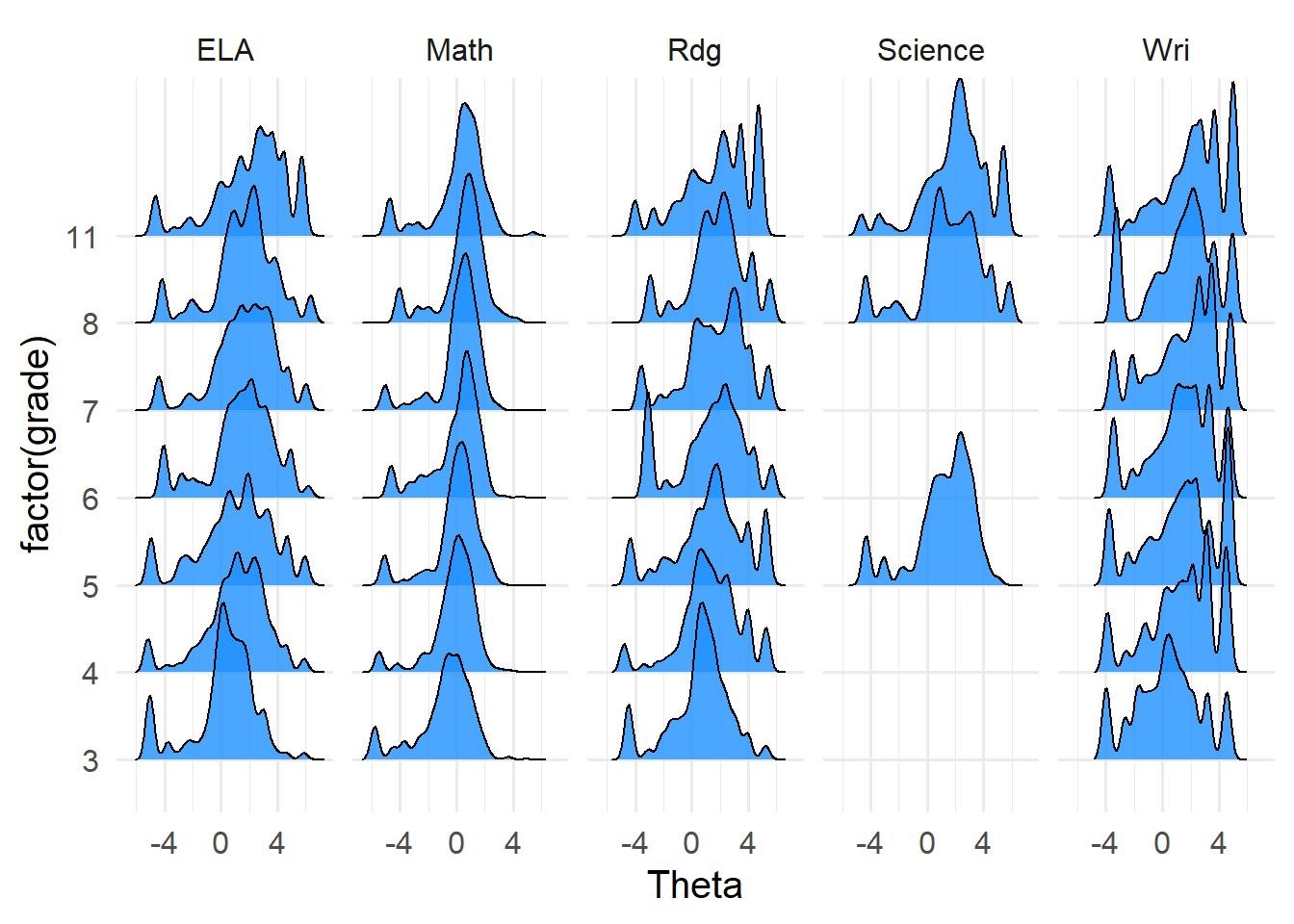
Quick look at distributions

library(ggridges)
ggplot(d, aes(x = Theta, y = factor(grade))) +
    geom_density_ridges(fill = "dodgerblue", alpha = 0.8, bandwidth = 0.3) +
    facet_wrap(~content, nrow = 1)

Summary stats

d |>
    group_by(grade, content, asmtprmrydsbltycd) |>
    summarize(mean = mean(Theta)) |>
    pivot_wider(names_from = content, 
                values_from = mean)
# A tibble: 77 × 7
# Groups:   grade [7]
   grade asmtprmrydsbltycd     ELA    Math    Rdg    Wri Science
   <int>             <dbl>   <dbl>   <dbl>  <dbl>  <dbl>   <dbl>
 1     3                 0 -0.0736 -1.21    1.01   1.61       NA
 2     3                10  0.370  -0.818   0.518  0.321      NA
 3     3                20 -0.0633 -1.25    1.52  -0.578      NA
 4     3                40 -1.88   -3.56   -1.76  -0.751      NA
 5     3                50  0.946  -0.0919  0.979  1.19       NA
 6     3                60  0.841   1.04    2.18   1.07       NA
 7     3                70 -1.10   -1.52   -0.845 -1.01       NA
 8     3                74  0.996   0.0208  0.6    1.29       NA
 9     3                80 -0.144  -0.533   0.679  0.269      NA
10     3                82  0.371  -1.08    0.568  0.344      NA
# ℹ 67 more rows

Backing up a bit

What if we wanted only math files?

dir_ls(here::here("data", "pfiles_sim"), regexp = "Math")
C:/Users/jnese/Desktop/BRT/Teaching/3_Functional-Programming/functional-programming_spring-2026/data/pfiles_sim/g11Mathpfiles18_sim.csv
C:/Users/jnese/Desktop/BRT/Teaching/3_Functional-Programming/functional-programming_spring-2026/data/pfiles_sim/g3Mathpfiles18_sim.csv
C:/Users/jnese/Desktop/BRT/Teaching/3_Functional-Programming/functional-programming_spring-2026/data/pfiles_sim/g4Mathpfiles18_sim.csv
C:/Users/jnese/Desktop/BRT/Teaching/3_Functional-Programming/functional-programming_spring-2026/data/pfiles_sim/g5Mathpfiles18_sim.csv
C:/Users/jnese/Desktop/BRT/Teaching/3_Functional-Programming/functional-programming_spring-2026/data/pfiles_sim/g6Mathpfiles18_sim.csv
C:/Users/jnese/Desktop/BRT/Teaching/3_Functional-Programming/functional-programming_spring-2026/data/pfiles_sim/g7Mathpfiles18_sim.csv
C:/Users/jnese/Desktop/BRT/Teaching/3_Functional-Programming/functional-programming_spring-2026/data/pfiles_sim/g8Mathpfiles18_sim.csv

Only Grade 5 files?

You try

. . .

g5_paths <- dir_ls(
  here::here("data", "pfiles_sim"), 
  regexp = "g5" 
)

The rest is the same

g5 <- map_dfr(g5_paths, read_csv, .id = "file") |>
  mutate(
      file = str_replace_all(
        file, 
        here::here("data", "pfiles_sim", "/"), 
        ""
      )
    )
g5
# A tibble: 2,632 × 23
   file   Entry  Theta Status Count RawScore    SE Infit Infit_Z Outfit Outfit_Z
   <chr>  <dbl>  <dbl>  <dbl> <dbl>    <dbl> <dbl> <dbl>   <dbl>  <dbl>    <dbl>
 1 g5ELA…   375  3.15       1    36       32 0.551  1.22    0.91   2.1      2.26
 2 g5ELA…   305  0.366      1    36       16 0.389  0.94   -0.31   0.98    -0.39
 3 g5ELA…   163 -4.95      -1    36        0 1.85   1       0      1        0   
 4 g5ELA…   524 -4.95      -1    36        0 1.85   1       0      1        0   
 5 g5ELA…    81  3.15       1    36       32 0.551  0.96    0      0.58    -0.24
 6 g5ELA…   325  1.72       1    36       25 0.400  1.14    0.92   1.23     0.57
 7 g5ELA…   163  1.88       1    36       26 0.408  0.82   -1.08   0.57    -0.91
 8 g5ELA…   116  5.93       0    36       36 1.84   1       0      1        0   
 9 g5ELA…   273  1.41       1    36       23 0.389  1.08    0.44   0.94     0.1 
10 g5ELA…   202  1.88       1    36       26 0.408  0.79   -0.84   0.76    -0.63
# ℹ 2,622 more rows
# ℹ 12 more variables: Displacement <dbl>, PointMeasureCorr <dbl>,
#   Weight <dbl>, ObservMatch <dbl>, ExpectMatch <dbl>,
#   PointMeasureExpected <dbl>, RMSR <dbl>, WMLE <dbl>, testeventid <dbl>,
#   ssid <dbl>, asmtprmrydsbltycd <dbl>, asmtscndrydsbltycd <dbl>

base equivalents

list.files(here::here("data", "pfiles_sim"))
 [1] "g11ELApfiles18_sim.csv"     "g11Mathpfiles18_sim.csv"   
 [3] "g11Rdgpfiles18_sim.csv"     "g11Sciencepfiles18_sim.csv"
 [5] "g11Wripfiles18_sim.csv"     "g3ELApfiles18_sim.csv"     
 [7] "g3Mathpfiles18_sim.csv"     "g3Rdgpfiles18_sim.csv"     
 [9] "g3Wripfiles18_sim.csv"      "g4ELApfiles18_sim.csv"     
[11] "g4Mathpfiles18_sim.csv"     "g4Rdgpfiles18_sim.csv"     
[13] "g4Wripfiles18_sim.csv"      "g5ELApfiles18_sim.csv"     
[15] "g5Mathpfiles18_sim.csv"     "g5Rdgpfiles18_sim.csv"     
[17] "g5Sciencepfiles18_sim.csv"  "g5Wripfiles18_sim.csv"     
[19] "g6ELApfiles18_sim.csv"      "g6Mathpfiles18_sim.csv"    
[21] "g6Rdgpfiles18_sim.csv"      "g6Wripfiles18_sim.csv"     
[23] "g7ELApfiles18_sim.csv"      "g7Mathpfiles18_sim.csv"    
[25] "g7Rdgpfiles18_sim.csv"      "g7Wripfiles18_sim.csv"     
[27] "g8ELApfiles18_sim.csv"      "g8Mathpfiles18_sim.csv"    
[29] "g8Rdgpfiles18_sim.csv"      "g8Sciencepfiles18_sim.csv" 
[31] "g8Wripfiles18_sim.csv"     

Full path

full.names = TRUE

list.files(here::here("data", "pfiles_sim"),
           full.names = TRUE)
 [1] "C:/Users/jnese/Desktop/BRT/Teaching/3_Functional-Programming/functional-programming_spring-2026/data/pfiles_sim/g11ELApfiles18_sim.csv"    
 [2] "C:/Users/jnese/Desktop/BRT/Teaching/3_Functional-Programming/functional-programming_spring-2026/data/pfiles_sim/g11Mathpfiles18_sim.csv"   
 [3] "C:/Users/jnese/Desktop/BRT/Teaching/3_Functional-Programming/functional-programming_spring-2026/data/pfiles_sim/g11Rdgpfiles18_sim.csv"    
 [4] "C:/Users/jnese/Desktop/BRT/Teaching/3_Functional-Programming/functional-programming_spring-2026/data/pfiles_sim/g11Sciencepfiles18_sim.csv"
 [5] "C:/Users/jnese/Desktop/BRT/Teaching/3_Functional-Programming/functional-programming_spring-2026/data/pfiles_sim/g11Wripfiles18_sim.csv"    
 [6] "C:/Users/jnese/Desktop/BRT/Teaching/3_Functional-Programming/functional-programming_spring-2026/data/pfiles_sim/g3ELApfiles18_sim.csv"     
 [7] "C:/Users/jnese/Desktop/BRT/Teaching/3_Functional-Programming/functional-programming_spring-2026/data/pfiles_sim/g3Mathpfiles18_sim.csv"    
 [8] "C:/Users/jnese/Desktop/BRT/Teaching/3_Functional-Programming/functional-programming_spring-2026/data/pfiles_sim/g3Rdgpfiles18_sim.csv"     
 [9] "C:/Users/jnese/Desktop/BRT/Teaching/3_Functional-Programming/functional-programming_spring-2026/data/pfiles_sim/g3Wripfiles18_sim.csv"     
[10] "C:/Users/jnese/Desktop/BRT/Teaching/3_Functional-Programming/functional-programming_spring-2026/data/pfiles_sim/g4ELApfiles18_sim.csv"     
[11] "C:/Users/jnese/Desktop/BRT/Teaching/3_Functional-Programming/functional-programming_spring-2026/data/pfiles_sim/g4Mathpfiles18_sim.csv"    
[12] "C:/Users/jnese/Desktop/BRT/Teaching/3_Functional-Programming/functional-programming_spring-2026/data/pfiles_sim/g4Rdgpfiles18_sim.csv"     
[13] "C:/Users/jnese/Desktop/BRT/Teaching/3_Functional-Programming/functional-programming_spring-2026/data/pfiles_sim/g4Wripfiles18_sim.csv"     
[14] "C:/Users/jnese/Desktop/BRT/Teaching/3_Functional-Programming/functional-programming_spring-2026/data/pfiles_sim/g5ELApfiles18_sim.csv"     
[15] "C:/Users/jnese/Desktop/BRT/Teaching/3_Functional-Programming/functional-programming_spring-2026/data/pfiles_sim/g5Mathpfiles18_sim.csv"    
[16] "C:/Users/jnese/Desktop/BRT/Teaching/3_Functional-Programming/functional-programming_spring-2026/data/pfiles_sim/g5Rdgpfiles18_sim.csv"     
[17] "C:/Users/jnese/Desktop/BRT/Teaching/3_Functional-Programming/functional-programming_spring-2026/data/pfiles_sim/g5Sciencepfiles18_sim.csv" 
[18] "C:/Users/jnese/Desktop/BRT/Teaching/3_Functional-Programming/functional-programming_spring-2026/data/pfiles_sim/g5Wripfiles18_sim.csv"     
[19] "C:/Users/jnese/Desktop/BRT/Teaching/3_Functional-Programming/functional-programming_spring-2026/data/pfiles_sim/g6ELApfiles18_sim.csv"     
[20] "C:/Users/jnese/Desktop/BRT/Teaching/3_Functional-Programming/functional-programming_spring-2026/data/pfiles_sim/g6Mathpfiles18_sim.csv"    
[21] "C:/Users/jnese/Desktop/BRT/Teaching/3_Functional-Programming/functional-programming_spring-2026/data/pfiles_sim/g6Rdgpfiles18_sim.csv"     
[22] "C:/Users/jnese/Desktop/BRT/Teaching/3_Functional-Programming/functional-programming_spring-2026/data/pfiles_sim/g6Wripfiles18_sim.csv"     
[23] "C:/Users/jnese/Desktop/BRT/Teaching/3_Functional-Programming/functional-programming_spring-2026/data/pfiles_sim/g7ELApfiles18_sim.csv"     
[24] "C:/Users/jnese/Desktop/BRT/Teaching/3_Functional-Programming/functional-programming_spring-2026/data/pfiles_sim/g7Mathpfiles18_sim.csv"    
[25] "C:/Users/jnese/Desktop/BRT/Teaching/3_Functional-Programming/functional-programming_spring-2026/data/pfiles_sim/g7Rdgpfiles18_sim.csv"     
[26] "C:/Users/jnese/Desktop/BRT/Teaching/3_Functional-Programming/functional-programming_spring-2026/data/pfiles_sim/g7Wripfiles18_sim.csv"     
[27] "C:/Users/jnese/Desktop/BRT/Teaching/3_Functional-Programming/functional-programming_spring-2026/data/pfiles_sim/g8ELApfiles18_sim.csv"     
[28] "C:/Users/jnese/Desktop/BRT/Teaching/3_Functional-Programming/functional-programming_spring-2026/data/pfiles_sim/g8Mathpfiles18_sim.csv"    
[29] "C:/Users/jnese/Desktop/BRT/Teaching/3_Functional-Programming/functional-programming_spring-2026/data/pfiles_sim/g8Rdgpfiles18_sim.csv"     
[30] "C:/Users/jnese/Desktop/BRT/Teaching/3_Functional-Programming/functional-programming_spring-2026/data/pfiles_sim/g8Sciencepfiles18_sim.csv" 
[31] "C:/Users/jnese/Desktop/BRT/Teaching/3_Functional-Programming/functional-programming_spring-2026/data/pfiles_sim/g8Wripfiles18_sim.csv"     

Only .csv

pattern = "__"

list.files(here::here("data", "pfiles_sim"), 
           full.names = TRUE,
           pattern = ".csv")
 [1] "C:/Users/jnese/Desktop/BRT/Teaching/3_Functional-Programming/functional-programming_spring-2026/data/pfiles_sim/g11ELApfiles18_sim.csv"    
 [2] "C:/Users/jnese/Desktop/BRT/Teaching/3_Functional-Programming/functional-programming_spring-2026/data/pfiles_sim/g11Mathpfiles18_sim.csv"   
 [3] "C:/Users/jnese/Desktop/BRT/Teaching/3_Functional-Programming/functional-programming_spring-2026/data/pfiles_sim/g11Rdgpfiles18_sim.csv"    
 [4] "C:/Users/jnese/Desktop/BRT/Teaching/3_Functional-Programming/functional-programming_spring-2026/data/pfiles_sim/g11Sciencepfiles18_sim.csv"
 [5] "C:/Users/jnese/Desktop/BRT/Teaching/3_Functional-Programming/functional-programming_spring-2026/data/pfiles_sim/g11Wripfiles18_sim.csv"    
 [6] "C:/Users/jnese/Desktop/BRT/Teaching/3_Functional-Programming/functional-programming_spring-2026/data/pfiles_sim/g3ELApfiles18_sim.csv"     
 [7] "C:/Users/jnese/Desktop/BRT/Teaching/3_Functional-Programming/functional-programming_spring-2026/data/pfiles_sim/g3Mathpfiles18_sim.csv"    
 [8] "C:/Users/jnese/Desktop/BRT/Teaching/3_Functional-Programming/functional-programming_spring-2026/data/pfiles_sim/g3Rdgpfiles18_sim.csv"     
 [9] "C:/Users/jnese/Desktop/BRT/Teaching/3_Functional-Programming/functional-programming_spring-2026/data/pfiles_sim/g3Wripfiles18_sim.csv"     
[10] "C:/Users/jnese/Desktop/BRT/Teaching/3_Functional-Programming/functional-programming_spring-2026/data/pfiles_sim/g4ELApfiles18_sim.csv"     
[11] "C:/Users/jnese/Desktop/BRT/Teaching/3_Functional-Programming/functional-programming_spring-2026/data/pfiles_sim/g4Mathpfiles18_sim.csv"    
[12] "C:/Users/jnese/Desktop/BRT/Teaching/3_Functional-Programming/functional-programming_spring-2026/data/pfiles_sim/g4Rdgpfiles18_sim.csv"     
[13] "C:/Users/jnese/Desktop/BRT/Teaching/3_Functional-Programming/functional-programming_spring-2026/data/pfiles_sim/g4Wripfiles18_sim.csv"     
[14] "C:/Users/jnese/Desktop/BRT/Teaching/3_Functional-Programming/functional-programming_spring-2026/data/pfiles_sim/g5ELApfiles18_sim.csv"     
[15] "C:/Users/jnese/Desktop/BRT/Teaching/3_Functional-Programming/functional-programming_spring-2026/data/pfiles_sim/g5Mathpfiles18_sim.csv"    
[16] "C:/Users/jnese/Desktop/BRT/Teaching/3_Functional-Programming/functional-programming_spring-2026/data/pfiles_sim/g5Rdgpfiles18_sim.csv"     
[17] "C:/Users/jnese/Desktop/BRT/Teaching/3_Functional-Programming/functional-programming_spring-2026/data/pfiles_sim/g5Sciencepfiles18_sim.csv" 
[18] "C:/Users/jnese/Desktop/BRT/Teaching/3_Functional-Programming/functional-programming_spring-2026/data/pfiles_sim/g5Wripfiles18_sim.csv"     
[19] "C:/Users/jnese/Desktop/BRT/Teaching/3_Functional-Programming/functional-programming_spring-2026/data/pfiles_sim/g6ELApfiles18_sim.csv"     
[20] "C:/Users/jnese/Desktop/BRT/Teaching/3_Functional-Programming/functional-programming_spring-2026/data/pfiles_sim/g6Mathpfiles18_sim.csv"    
[21] "C:/Users/jnese/Desktop/BRT/Teaching/3_Functional-Programming/functional-programming_spring-2026/data/pfiles_sim/g6Rdgpfiles18_sim.csv"     
[22] "C:/Users/jnese/Desktop/BRT/Teaching/3_Functional-Programming/functional-programming_spring-2026/data/pfiles_sim/g6Wripfiles18_sim.csv"     
[23] "C:/Users/jnese/Desktop/BRT/Teaching/3_Functional-Programming/functional-programming_spring-2026/data/pfiles_sim/g7ELApfiles18_sim.csv"     
[24] "C:/Users/jnese/Desktop/BRT/Teaching/3_Functional-Programming/functional-programming_spring-2026/data/pfiles_sim/g7Mathpfiles18_sim.csv"    
[25] "C:/Users/jnese/Desktop/BRT/Teaching/3_Functional-Programming/functional-programming_spring-2026/data/pfiles_sim/g7Rdgpfiles18_sim.csv"     
[26] "C:/Users/jnese/Desktop/BRT/Teaching/3_Functional-Programming/functional-programming_spring-2026/data/pfiles_sim/g7Wripfiles18_sim.csv"     
[27] "C:/Users/jnese/Desktop/BRT/Teaching/3_Functional-Programming/functional-programming_spring-2026/data/pfiles_sim/g8ELApfiles18_sim.csv"     
[28] "C:/Users/jnese/Desktop/BRT/Teaching/3_Functional-Programming/functional-programming_spring-2026/data/pfiles_sim/g8Mathpfiles18_sim.csv"    
[29] "C:/Users/jnese/Desktop/BRT/Teaching/3_Functional-Programming/functional-programming_spring-2026/data/pfiles_sim/g8Rdgpfiles18_sim.csv"     
[30] "C:/Users/jnese/Desktop/BRT/Teaching/3_Functional-Programming/functional-programming_spring-2026/data/pfiles_sim/g8Sciencepfiles18_sim.csv" 
[31] "C:/Users/jnese/Desktop/BRT/Teaching/3_Functional-Programming/functional-programming_spring-2026/data/pfiles_sim/g8Wripfiles18_sim.csv"     

So why not use base?

  • We could, but {fs} plays a little nicer with {purrr}

. . .

files <- list.files(
  here::here("data", "pfiles_sim"), 
  pattern = "*.csv"
)
batch3 <- map_dfr(files, read_csv, .id = "file")
Error in `map()`:
ℹ In index: 1.
Caused by error:
! 'g11ELApfiles18_sim.csv' does not exist in current working directory ('C:/Users/jnese/Desktop/BRT/Teaching/3_Functional-Programming/functional-programming_spring-2026/slides').

. . .

Need to return full names

files
 [1] "g11ELApfiles18_sim.csv"     "g11Mathpfiles18_sim.csv"   
 [3] "g11Rdgpfiles18_sim.csv"     "g11Sciencepfiles18_sim.csv"
 [5] "g11Wripfiles18_sim.csv"     "g3ELApfiles18_sim.csv"     
 [7] "g3Mathpfiles18_sim.csv"     "g3Rdgpfiles18_sim.csv"     
 [9] "g3Wripfiles18_sim.csv"      "g4ELApfiles18_sim.csv"     
[11] "g4Mathpfiles18_sim.csv"     "g4Rdgpfiles18_sim.csv"     
[13] "g4Wripfiles18_sim.csv"      "g5ELApfiles18_sim.csv"     
[15] "g5Mathpfiles18_sim.csv"     "g5Rdgpfiles18_sim.csv"     
[17] "g5Sciencepfiles18_sim.csv"  "g5Wripfiles18_sim.csv"     
[19] "g6ELApfiles18_sim.csv"      "g6Mathpfiles18_sim.csv"    
[21] "g6Rdgpfiles18_sim.csv"      "g6Wripfiles18_sim.csv"     
[23] "g7ELApfiles18_sim.csv"      "g7Mathpfiles18_sim.csv"    
[25] "g7Rdgpfiles18_sim.csv"      "g7Wripfiles18_sim.csv"     
[27] "g8ELApfiles18_sim.csv"      "g8Mathpfiles18_sim.csv"    
[29] "g8Rdgpfiles18_sim.csv"      "g8Sciencepfiles18_sim.csv" 
[31] "g8Wripfiles18_sim.csv"     

Try again

files <- list.files(here::here("data", "pfiles_sim"), 
                    pattern = "*.csv", 
                    full.names = TRUE)
batch3 <- map_dfr(files, read_csv, .id = "file")
batch3
# A tibble: 15,945 × 23
   file  Entry  Theta Status Count RawScore    SE Infit Infit_Z Outfit Outfit_Z
   <chr> <dbl>  <dbl>  <dbl> <dbl>    <dbl> <dbl> <dbl>   <dbl>  <dbl>    <dbl>
 1 1       123  1.27       1    36       23 0.371  0.93   -0.34   0.82    -0.62
 2 1        88  1.55       1    36       25 0.385  0.95   -0.37   0.81    -0.56
 3 1       105  3.28       1    36       33 0.619  0.9    -0.04   1.63     1.03
 4 1       153  4.48       1    36       35 1.02   0.93    0.23   0.35    -0.16
 5 1       437  2.67       1    36       31 0.501  0.92   -0.18   0.88    -0.12
 6 1       307  5.71       0    36       36 1.84   1       0      1        0   
 7 1       305  3.73       1    36       34 0.741  1.06    0.31   0.86     0.17
 8 1        42  0.609      1    36       18 0.36   1.55    2.56   1.74     3.31
 9 1        59 -2.62       1    36        3 1.03   0.85    0.06   0.17    -0.37
10 1       304  5.71       0    36       36 1.84   1       0      1        0   
# ℹ 15,935 more rows
# ℹ 12 more variables: Displacement <dbl>, PointMeasureCorr <dbl>,
#   Weight <dbl>, ObservMatch <dbl>, ExpectMatch <dbl>,
#   PointMeasureExpected <dbl>, RMSR <dbl>, WMLE <dbl>, testeventid <dbl>,
#   ssid <dbl>, asmtprmrydsbltycd <dbl>, asmtscndrydsbltycd <dbl>

indexes

The prior example gave us indexes, rather than the file path. Why?

. . .

files does not have names

names(files)
NULL

. . .

We need the file path! An index isn’t nearly as useful

Base method that works

files <- list.files(here::here("data", "pfiles_sim"), 
                    pattern = "*.csv", 
                    full.names = TRUE) 
files <- setNames(files, files)

batch4 <- map_dfr(files, read_csv, .id = "file")
batch4
# A tibble: 15,945 × 23
   file   Entry  Theta Status Count RawScore    SE Infit Infit_Z Outfit Outfit_Z
   <chr>  <dbl>  <dbl>  <dbl> <dbl>    <dbl> <dbl> <dbl>   <dbl>  <dbl>    <dbl>
 1 C:/Us…   123  1.27       1    36       23 0.371  0.93   -0.34   0.82    -0.62
 2 C:/Us…    88  1.55       1    36       25 0.385  0.95   -0.37   0.81    -0.56
 3 C:/Us…   105  3.28       1    36       33 0.619  0.9    -0.04   1.63     1.03
 4 C:/Us…   153  4.48       1    36       35 1.02   0.93    0.23   0.35    -0.16
 5 C:/Us…   437  2.67       1    36       31 0.501  0.92   -0.18   0.88    -0.12
 6 C:/Us…   307  5.71       0    36       36 1.84   1       0      1        0   
 7 C:/Us…   305  3.73       1    36       34 0.741  1.06    0.31   0.86     0.17
 8 C:/Us…    42  0.609      1    36       18 0.36   1.55    2.56   1.74     3.31
 9 C:/Us…    59 -2.62       1    36        3 1.03   0.85    0.06   0.17    -0.37
10 C:/Us…   304  5.71       0    36       36 1.84   1       0      1        0   
# ℹ 15,935 more rows
# ℹ 12 more variables: Displacement <dbl>, PointMeasureCorr <dbl>,
#   Weight <dbl>, ObservMatch <dbl>, ExpectMatch <dbl>,
#   PointMeasureExpected <dbl>, RMSR <dbl>, WMLE <dbl>, testeventid <dbl>,
#   ssid <dbl>, asmtprmrydsbltycd <dbl>, asmtscndrydsbltycd <dbl>

My recommendation

  • If you’re working interactively, no reason not to use {fs}
  • If you are building functions that take paths, might be worth considering skipping the package dependency
  • I am not saying don’t use {fs}, but just consider whether it is really needed or not

List columns

Comparing models

Let’s say we wanted to fit/compare a set of models for each content area

  1. lm(Theta ~ asmtprmrydsbltycd)

  2. lm(Theta ~ asmtprmrydsbltycd + asmtscndrydsbltycd)

  3. lm(Theta ~ asmtprmrydsbltycd * asmtscndrydsbltycd)

Data pre-processing

  • The disability variables are stored as numbers, we need them as factors
  • We’ll make the names easier in the process
d <- d |>
    mutate(primary = as.factor(asmtprmrydsbltycd),
           secondary = as.factor(asmtscndrydsbltycd))

Split the data

The base method we’ve been using…

splt_content <- split(d, d$content)
str(splt_content)
List of 5
 $ ELA    : tibble [3,627 × 27] (S3: tbl_df/tbl/data.frame)
  ..$ ssid                : num [1:3627] 9466908 7683685 9025693 10099824 18886078 ...
  ..$ grade               : int [1:3627] 11 11 11 11 11 11 11 11 11 11 ...
  ..$ year                : int [1:3627] 11 11 11 11 11 11 11 11 11 11 ...
  ..$ content             : chr [1:3627] "ELA" "ELA" "ELA" "ELA" ...
  ..$ testeventid         : num [1:3627] 148933 147875 143699 143962 150680 ...
  ..$ asmtprmrydsbltycd   : num [1:3627] 0 10 40 82 10 80 50 10 50 82 ...
  ..$ asmtscndrydsbltycd  : num [1:3627] 0 0 20 0 0 80 0 0 0 0 ...
  ..$ Entry               : num [1:3627] 123 88 105 153 437 307 305 42 59 304 ...
  ..$ Theta               : num [1:3627] 1.27 1.55 3.28 4.48 2.67 ...
  ..$ Status              : num [1:3627] 1 1 1 1 1 0 1 1 1 0 ...
  ..$ Count               : num [1:3627] 36 36 36 36 36 36 36 36 36 36 ...
  ..$ RawScore            : num [1:3627] 23 25 33 35 31 36 34 18 3 36 ...
  ..$ SE                  : num [1:3627] 0.371 0.385 0.619 1.023 0.501 ...
  ..$ Infit               : num [1:3627] 0.93 0.95 0.9 0.93 0.92 1 1.06 1.55 0.85 1 ...
  ..$ Infit_Z             : num [1:3627] -0.34 -0.37 -0.04 0.23 -0.18 0 0.31 2.56 0.06 0 ...
  ..$ Outfit              : num [1:3627] 0.82 0.81 1.63 0.35 0.88 1 0.86 1.74 0.17 1 ...
  ..$ Outfit_Z            : num [1:3627] -0.62 -0.56 1.03 -0.16 -0.12 0 0.17 3.31 -0.37 0 ...
  ..$ Displacement        : num [1:3627] 0.0018 0.0019 0.0022 0.0023 0.0021 0.0024 0.0022 0.0017 0.0009 0.0024 ...
  ..$ PointMeasureCorr    : num [1:3627] 0.42 0.42 0.3 0.27 0.31 0 0.14 -0.12 0.32 0 ...
  ..$ Weight              : num [1:3627] 1 1 1 1 1 1 1 1 1 1 ...
  ..$ ObservMatch         : num [1:3627] 75 80.6 91.7 97.2 86.1 100 94.4 50 97.2 100 ...
  ..$ ExpectMatch         : num [1:3627] 68.3 72 91.7 97.2 86.1 100 94.4 65 97.2 100 ...
  ..$ PointMeasureExpected: num [1:3627] 0.35 0.33 0.2 0.12 0.25 0 0.17 0.38 0.17 0 ...
  ..$ RMSR                : num [1:3627] 0.42 0.39 0.26 0.16 0.31 0 0.23 0.51 0.14 0 ...
  ..$ WMLE                : num [1:3627] 1.25 1.68 3.13 4 2.59 ...
  ..$ primary             : Factor w/ 12 levels "0","10","20",..: 1 2 4 11 2 10 6 2 6 11 ...
  ..$ secondary           : Factor w/ 12 levels "0","10","20",..: 1 1 3 1 1 10 1 1 1 1 ...
 $ Math   : tibble [3,629 × 27] (S3: tbl_df/tbl/data.frame)
  ..$ ssid                : num [1:3629] 10129634 10926496 10616063 10139443 8887381 ...
  ..$ grade               : int [1:3629] 11 11 11 11 11 11 11 11 11 11 ...
  ..$ year                : int [1:3629] 11 11 11 11 11 11 11 11 11 11 ...
  ..$ content             : chr [1:3629] "Math" "Math" "Math" "Math" ...
  ..$ testeventid         : num [1:3629] 147564 151249 146976 151229 147676 ...
  ..$ asmtprmrydsbltycd   : num [1:3629] 10 80 10 10 80 82 10 10 40 82 ...
  ..$ asmtscndrydsbltycd  : num [1:3629] 0 90 0 0 10 80 50 0 50 0 ...
  ..$ Entry               : num [1:3629] 161 344 321 167 101 131 141 357 14 367 ...
  ..$ Theta               : num [1:3629] 0.514 1.965 0.899 1.965 -4.724 ...
  ..$ Status              : num [1:3629] 1 1 1 1 -1 1 1 1 1 1 ...
  ..$ Count               : num [1:3629] 36 36 36 36 36 36 36 36 36 36 ...
  ..$ RawScore            : num [1:3629] 19 29 22 29 0 14 18 25 19 22 ...
  ..$ SE                  : num [1:3629] 0.356 0.436 0.362 0.436 1.839 ...
  ..$ Infit               : num [1:3629] 0.97 1.03 0.99 1 1 1.01 0.99 0.85 0.96 1.06 ...
  ..$ Infit_Z             : num [1:3629] -0.18 0.26 -0.09 0.1 0 0.13 -0.06 -0.81 -0.39 0.5 ...
  ..$ Outfit              : num [1:3629] 0.97 1.03 1.01 0.87 1 0.93 1 0.77 0.97 0.99 ...
  ..$ Outfit_Z            : num [1:3629] -0.17 0.23 0.17 -0.46 0 -0.03 0.03 -0.87 -0.19 0.07 ...
  ..$ Displacement        : num [1:3629] 5e-04 5e-04 5e-04 5e-04 -7e-04 4e-04 5e-04 5e-04 5e-04 5e-04 ...
  ..$ PointMeasureCorr    : num [1:3629] 0.38 0.28 0.34 0.29 0 0.34 0.38 0.45 0.38 0.27 ...
  ..$ Weight              : num [1:3629] 1 1 1 1 1 1 1 1 1 1 ...
  ..$ ObservMatch         : num [1:3629] 66.7 80.6 66.7 80.6 100 61.1 69.4 75 63.9 61.1 ...
  ..$ ExpectMatch         : num [1:3629] 64.4 80.5 66 80.5 100 68.3 64.6 70.3 64.4 66 ...
  ..$ PointMeasureExpected: num [1:3629] 0.35 0.25 0.33 0.25 0 0.35 0.35 0.3 0.35 0.33 ...
  ..$ RMSR                : num [1:3629] 0.46 0.39 0.45 0.39 0 0.46 0.46 0.4 0.46 0.48 ...
  ..$ WMLE                : num [1:3629] 0.512 1.915 0.888 1.915 -4.724 ...
  ..$ primary             : Factor w/ 12 levels "0","10","20",..: 2 10 2 2 10 11 2 2 4 11 ...
  ..$ secondary           : Factor w/ 12 levels "0","10","20",..: 1 12 1 1 2 10 6 1 6 1 ...
 $ Rdg    : tibble [3,627 × 27] (S3: tbl_df/tbl/data.frame)
  ..$ ssid                : num [1:3627] 18631185 18342736 10897771 7663935 6709613 ...
  ..$ grade               : int [1:3627] 11 11 11 11 11 11 11 11 11 11 ...
  ..$ year                : int [1:3627] 11 11 11 11 11 11 11 11 11 11 ...
  ..$ content             : chr [1:3627] "Rdg" "Rdg" "Rdg" "Rdg" ...
  ..$ testeventid         : num [1:3627] 145641 147717 145196 149014 146545 ...
  ..$ asmtprmrydsbltycd   : num [1:3627] 10 90 10 80 0 10 10 80 82 82 ...
  ..$ asmtscndrydsbltycd  : num [1:3627] 0 0 0 10 0 82 0 70 0 0 ...
  ..$ Entry               : num [1:3627] 444 444 343 74 3 77 181 261 297 182 ...
  ..$ Theta               : num [1:3627] 2.24 3.48 2.72 -2.72 0.12 -1.39 -0.67 4.73 4.73 4.73 ...
  ..$ Status              : num [1:3627] 1 1 1 1 1 1 1 0 0 0 ...
  ..$ Count               : num [1:3627] 19 19 19 19 19 19 19 19 19 19 ...
  ..$ RawScore            : num [1:3627] 16 18 17 1 8 3 5 19 19 19 ...
  ..$ SE                  : num [1:3627] 0.64 1.03 0.76 1.06 0.49 0.66 0.55 1.84 1.84 1.84 ...
  ..$ Infit               : num [1:3627] 1.07 1.02 1.1 1 0.98 0.73 1.08 1 1 1 ...
  ..$ Infit_Z             : num [1:3627] 0.29 0.31 0.53 0.29 -0.11 -0.54 0.37 0 0 0 ...
  ..$ Outfit              : num [1:3627] 1.17 0.94 1.22 0.76 0.95 0.62 1.09 1 1 1 ...
  ..$ Outfit_Z            : num [1:3627] 0.45 0.32 0.71 0 -0.22 -0.62 0.42 0 0 0 ...
  ..$ Displacement        : num [1:3627] 0 0 0 0 0 0 0 0 0 0 ...
  ..$ PointMeasureCorr    : num [1:3627] 0.01 0.08 0.05 0 0.32 0.68 0.2 0 0 0 ...
  ..$ Weight              : num [1:3627] 1 1 1 1 1 1 1 1 1 1 ...
  ..$ ObservMatch         : num [1:3627] 84.2 94.7 89.5 94.7 63.2 84.2 78.9 100 100 100 ...
  ..$ ExpectMatch         : num [1:3627] 84.2 94.7 89.5 94.7 64.2 85.1 76.3 100 100 100 ...
  ..$ PointMeasureExpected: num [1:3627] 0.17 0.1 0.14 0.24 0.3 0.31 0.32 0 0 0 ...
  ..$ RMSR                : num [1:3627] 0.38 0.22 0.31 0.22 0.47 0.34 0.36 0 0 0 ...
  ..$ WMLE                : num [1:3627] 2.11 3.02 2.5 -2.27 0.14 -0.9 -0.6 4.73 4.73 4.73 ...
  ..$ primary             : Factor w/ 12 levels "0","10","20",..: 2 12 2 10 1 2 2 10 11 11 ...
  ..$ secondary           : Factor w/ 12 levels "0","10","20",..: 1 1 1 2 1 11 1 8 1 1 ...
 $ Science: tibble [1,435 × 27] (S3: tbl_df/tbl/data.frame)
  ..$ ssid                : num [1:1435] 7617607 7642717 10341706 9811494 10469745 ...
  ..$ grade               : int [1:1435] 11 11 11 11 11 11 11 11 11 11 ...
  ..$ year                : int [1:1435] 11 11 11 11 11 11 11 11 11 11 ...
  ..$ content             : chr [1:1435] "Science" "Science" "Science" "Science" ...
  ..$ testeventid         : num [1:1435] 148838 144146 149634 146456 144426 ...
  ..$ asmtprmrydsbltycd   : num [1:1435] 10 82 80 10 90 10 10 80 80 10 ...
  ..$ asmtscndrydsbltycd  : num [1:1435] 0 80 20 0 50 80 70 0 50 0 ...
  ..$ Entry               : num [1:1435] 28 43 274 118 291 91 58 130 297 337 ...
  ..$ Theta               : num [1:1435] 0.875 2.647 4.17 5.404 5.404 ...
  ..$ Status              : num [1:1435] 1 1 1 0 0 1 1 1 1 1 ...
  ..$ Count               : num [1:1435] 36 36 36 36 36 36 36 36 36 36 ...
  ..$ RawScore            : num [1:1435] 22 32 35 36 36 26 2 34 34 28 ...
  ..$ SE                  : num [1:1435] 0.361 0.544 1.021 1.835 1.835 ...
  ..$ Infit               : num [1:1435] 1.3 0.94 1.05 1.04 0.99 0.9 0.97 0.99 0.98 0.9 ...
  ..$ Infit_Z             : num [1:1435] 2.35 0.02 0.37 0.35 0 -0.62 0.17 0.15 0.16 -0.52 ...
  ..$ Outfit              : num [1:1435] 1.22 0.76 1.5 1.2 0.48 0.85 0.69 1.57 0.67 0.8 ...
  ..$ Outfit_Z            : num [1:1435] 1.87 -0.27 0.91 0.6 -0.16 -0.87 -0.41 0.74 0.01 -0.76 ...
  ..$ Displacement        : num [1:1435] 0.0011 0.0016 0.0016 0.0027 0.0027 0.0013 0.0007 0.0016 0.0016 0.0014 ...
  ..$ PointMeasureCorr    : num [1:1435] 0.07 0.3 -0.07 0 0.29 0.46 0.28 0.05 0.22 0.45 ...
  ..$ Weight              : num [1:1435] 1 1 1 1 1 1 1 1 1 1 ...
  ..$ ObservMatch         : num [1:1435] 55.6 88.9 97.2 100 100 75 94.4 94.4 94.4 80.6 ...
  ..$ ExpectMatch         : num [1:1435] 66.1 88.9 97.2 100 100 73.2 94.4 94.4 94.4 77.9 ...
  ..$ PointMeasureExpected: num [1:1435] 0.32 0.22 0.12 0 0 0.3 0.15 0.16 0.16 0.28 ...
  ..$ RMSR                : num [1:1435] 0.52 0.3 0.17 0 0 0.39 0.22 0.22 0.22 0.36 ...
  ..$ WMLE                : num [1:1435] 0.863 2.543 3.692 5.404 5.404 ...
  ..$ primary             : Factor w/ 12 levels "0","10","20",..: 2 11 10 2 12 2 2 10 10 2 ...
  ..$ secondary           : Factor w/ 12 levels "0","10","20",..: 1 10 3 1 6 10 8 1 6 1 ...
 $ Wri    : tibble [3,627 × 27] (S3: tbl_df/tbl/data.frame)
  ..$ ssid                : num [1:3627] 7653093 7640498 7650957 9305807 18060455 ...
  ..$ grade               : int [1:3627] 11 11 11 11 11 11 11 11 11 11 ...
  ..$ year                : int [1:3627] 11 11 11 11 11 11 11 11 11 11 ...
  ..$ content             : chr [1:3627] "Wri" "Wri" "Wri" "Wri" ...
  ..$ testeventid         : num [1:3627] 148893 148868 144397 148988 144865 ...
  ..$ asmtprmrydsbltycd   : num [1:3627] 10 10 90 0 82 10 80 0 10 82 ...
  ..$ asmtscndrydsbltycd  : num [1:3627] 0 0 80 0 0 0 50 0 0 10 ...
  ..$ Entry               : num [1:3627] 61 48 63 107 443 214 267 344 423 27 ...
  ..$ Theta               : num [1:3627] 1.67 2.17 -1.56 5.01 2.17 0.38 0.79 5.01 -0.48 2.78 ...
  ..$ Status              : num [1:3627] 1 1 1 0 1 1 1 0 1 1 ...
  ..$ Count               : num [1:3627] 13 13 13 13 13 13 13 13 13 13 ...
  ..$ RawScore            : num [1:3627] 9 10 2 13 10 6 7 13 4 11 ...
  ..$ SE                  : num [1:3627] 0.69 0.74 0.83 1.87 0.74 0.64 0.65 1.87 0.68 0.84 ...
  ..$ Infit               : num [1:3627] 0.52 0.65 0.61 1 1.01 0.46 0.47 1 0.9 0.88 ...
  ..$ Infit_Z             : num [1:3627] -2.07 -1.02 -0.79 0 0.24 -2.3 -2.2 0 -0.16 -0.21 ...
  ..$ Outfit              : num [1:3627] 0.44 0.52 0.33 1 0.74 0.41 0.4 1 1.32 0.54 ...
  ..$ Outfit_Z            : num [1:3627] -1.65 -0.81 -0.47 0 -0.06 -1.88 -1.85 0 -0.14 -0.16 ...
  ..$ Displacement        : num [1:3627] 0 0 0 0 0 0 0 0 0 0 ...
  ..$ PointMeasureCorr    : num [1:3627] 0.86 0.73 0.62 0 0.51 0.87 0.87 0 0.56 0.56 ...
  ..$ Weight              : num [1:3627] 1 1 1 1 1 1 1 1 1 1 ...
  ..$ ObservMatch         : num [1:3627] 100 92.3 84.6 100 76.9 100 100 100 92.3 84.6 ...
  ..$ ExpectMatch         : num [1:3627] 75.5 79.7 84.6 100 79.7 72.9 73 100 74.5 84.6 ...
  ..$ PointMeasureExpected: num [1:3627] 0.48 0.44 0.34 0 0.44 0.5 0.51 0 0.45 0.38 ...
  ..$ RMSR                : num [1:3627] 0.31 0.34 0.26 0 0.38 0.29 0.29 0 0.37 0.31 ...
  ..$ WMLE                : num [1:3627] 1.61 2.08 -1.38 5.01 2.08 0.38 0.78 5.01 -0.43 2.61 ...
  ..$ primary             : Factor w/ 12 levels "0","10","20",..: 2 2 12 1 11 2 10 1 2 11 ...
  ..$ secondary           : Factor w/ 12 levels "0","10","20",..: 1 1 10 1 1 1 6 1 1 2 ...
We could use this method

Then conduct tests to see which model fit better, etc.

m1 <- map(
  splt_content, 
  ~lm(Theta ~ asmtprmrydsbltycd, data = .x)
)

m2 <- map(
  splt_content, 
  ~lm(Theta ~ asmtprmrydsbltycd + asmtscndrydsbltycd, 
      data = .x)
)

m3 <- map(
  splt_content, 
  ~lm(Theta ~ asmtprmrydsbltycd * asmtscndrydsbltycd, 
      data = .x)
)

Alternative

Create a data frame with a list column

(by_content <- d |>
  group_by(content) |> 
  nest())
# A tibble: 5 × 2
# Groups:   content [5]
  content data                 
  <chr>   <list>               
1 ELA     <tibble [3,627 × 26]>
2 Math    <tibble [3,629 × 26]>
3 Rdg     <tibble [3,627 × 26]>
4 Science <tibble [1,435 × 26]>
5 Wri     <tibble [3,627 × 26]>

What’s going on here?

str(by_content$data)
List of 5
 $ : tibble [3,627 × 26] (S3: tbl_df/tbl/data.frame)
  ..$ ssid                : num [1:3627] 9466908 7683685 9025693 10099824 18886078 ...
  ..$ grade               : int [1:3627] 11 11 11 11 11 11 11 11 11 11 ...
  ..$ year                : int [1:3627] 11 11 11 11 11 11 11 11 11 11 ...
  ..$ testeventid         : num [1:3627] 148933 147875 143699 143962 150680 ...
  ..$ asmtprmrydsbltycd   : num [1:3627] 0 10 40 82 10 80 50 10 50 82 ...
  ..$ asmtscndrydsbltycd  : num [1:3627] 0 0 20 0 0 80 0 0 0 0 ...
  ..$ Entry               : num [1:3627] 123 88 105 153 437 307 305 42 59 304 ...
  ..$ Theta               : num [1:3627] 1.27 1.55 3.28 4.48 2.67 ...
  ..$ Status              : num [1:3627] 1 1 1 1 1 0 1 1 1 0 ...
  ..$ Count               : num [1:3627] 36 36 36 36 36 36 36 36 36 36 ...
  ..$ RawScore            : num [1:3627] 23 25 33 35 31 36 34 18 3 36 ...
  ..$ SE                  : num [1:3627] 0.371 0.385 0.619 1.023 0.501 ...
  ..$ Infit               : num [1:3627] 0.93 0.95 0.9 0.93 0.92 1 1.06 1.55 0.85 1 ...
  ..$ Infit_Z             : num [1:3627] -0.34 -0.37 -0.04 0.23 -0.18 0 0.31 2.56 0.06 0 ...
  ..$ Outfit              : num [1:3627] 0.82 0.81 1.63 0.35 0.88 1 0.86 1.74 0.17 1 ...
  ..$ Outfit_Z            : num [1:3627] -0.62 -0.56 1.03 -0.16 -0.12 0 0.17 3.31 -0.37 0 ...
  ..$ Displacement        : num [1:3627] 0.0018 0.0019 0.0022 0.0023 0.0021 0.0024 0.0022 0.0017 0.0009 0.0024 ...
  ..$ PointMeasureCorr    : num [1:3627] 0.42 0.42 0.3 0.27 0.31 0 0.14 -0.12 0.32 0 ...
  ..$ Weight              : num [1:3627] 1 1 1 1 1 1 1 1 1 1 ...
  ..$ ObservMatch         : num [1:3627] 75 80.6 91.7 97.2 86.1 100 94.4 50 97.2 100 ...
  ..$ ExpectMatch         : num [1:3627] 68.3 72 91.7 97.2 86.1 100 94.4 65 97.2 100 ...
  ..$ PointMeasureExpected: num [1:3627] 0.35 0.33 0.2 0.12 0.25 0 0.17 0.38 0.17 0 ...
  ..$ RMSR                : num [1:3627] 0.42 0.39 0.26 0.16 0.31 0 0.23 0.51 0.14 0 ...
  ..$ WMLE                : num [1:3627] 1.25 1.68 3.13 4 2.59 ...
  ..$ primary             : Factor w/ 12 levels "0","10","20",..: 1 2 4 11 2 10 6 2 6 11 ...
  ..$ secondary           : Factor w/ 12 levels "0","10","20",..: 1 1 3 1 1 10 1 1 1 1 ...
 $ : tibble [3,629 × 26] (S3: tbl_df/tbl/data.frame)
  ..$ ssid                : num [1:3629] 10129634 10926496 10616063 10139443 8887381 ...
  ..$ grade               : int [1:3629] 11 11 11 11 11 11 11 11 11 11 ...
  ..$ year                : int [1:3629] 11 11 11 11 11 11 11 11 11 11 ...
  ..$ testeventid         : num [1:3629] 147564 151249 146976 151229 147676 ...
  ..$ asmtprmrydsbltycd   : num [1:3629] 10 80 10 10 80 82 10 10 40 82 ...
  ..$ asmtscndrydsbltycd  : num [1:3629] 0 90 0 0 10 80 50 0 50 0 ...
  ..$ Entry               : num [1:3629] 161 344 321 167 101 131 141 357 14 367 ...
  ..$ Theta               : num [1:3629] 0.514 1.965 0.899 1.965 -4.724 ...
  ..$ Status              : num [1:3629] 1 1 1 1 -1 1 1 1 1 1 ...
  ..$ Count               : num [1:3629] 36 36 36 36 36 36 36 36 36 36 ...
  ..$ RawScore            : num [1:3629] 19 29 22 29 0 14 18 25 19 22 ...
  ..$ SE                  : num [1:3629] 0.356 0.436 0.362 0.436 1.839 ...
  ..$ Infit               : num [1:3629] 0.97 1.03 0.99 1 1 1.01 0.99 0.85 0.96 1.06 ...
  ..$ Infit_Z             : num [1:3629] -0.18 0.26 -0.09 0.1 0 0.13 -0.06 -0.81 -0.39 0.5 ...
  ..$ Outfit              : num [1:3629] 0.97 1.03 1.01 0.87 1 0.93 1 0.77 0.97 0.99 ...
  ..$ Outfit_Z            : num [1:3629] -0.17 0.23 0.17 -0.46 0 -0.03 0.03 -0.87 -0.19 0.07 ...
  ..$ Displacement        : num [1:3629] 5e-04 5e-04 5e-04 5e-04 -7e-04 4e-04 5e-04 5e-04 5e-04 5e-04 ...
  ..$ PointMeasureCorr    : num [1:3629] 0.38 0.28 0.34 0.29 0 0.34 0.38 0.45 0.38 0.27 ...
  ..$ Weight              : num [1:3629] 1 1 1 1 1 1 1 1 1 1 ...
  ..$ ObservMatch         : num [1:3629] 66.7 80.6 66.7 80.6 100 61.1 69.4 75 63.9 61.1 ...
  ..$ ExpectMatch         : num [1:3629] 64.4 80.5 66 80.5 100 68.3 64.6 70.3 64.4 66 ...
  ..$ PointMeasureExpected: num [1:3629] 0.35 0.25 0.33 0.25 0 0.35 0.35 0.3 0.35 0.33 ...
  ..$ RMSR                : num [1:3629] 0.46 0.39 0.45 0.39 0 0.46 0.46 0.4 0.46 0.48 ...
  ..$ WMLE                : num [1:3629] 0.512 1.915 0.888 1.915 -4.724 ...
  ..$ primary             : Factor w/ 12 levels "0","10","20",..: 2 10 2 2 10 11 2 2 4 11 ...
  ..$ secondary           : Factor w/ 12 levels "0","10","20",..: 1 12 1 1 2 10 6 1 6 1 ...
 $ : tibble [3,627 × 26] (S3: tbl_df/tbl/data.frame)
  ..$ ssid                : num [1:3627] 18631185 18342736 10897771 7663935 6709613 ...
  ..$ grade               : int [1:3627] 11 11 11 11 11 11 11 11 11 11 ...
  ..$ year                : int [1:3627] 11 11 11 11 11 11 11 11 11 11 ...
  ..$ testeventid         : num [1:3627] 145641 147717 145196 149014 146545 ...
  ..$ asmtprmrydsbltycd   : num [1:3627] 10 90 10 80 0 10 10 80 82 82 ...
  ..$ asmtscndrydsbltycd  : num [1:3627] 0 0 0 10 0 82 0 70 0 0 ...
  ..$ Entry               : num [1:3627] 444 444 343 74 3 77 181 261 297 182 ...
  ..$ Theta               : num [1:3627] 2.24 3.48 2.72 -2.72 0.12 -1.39 -0.67 4.73 4.73 4.73 ...
  ..$ Status              : num [1:3627] 1 1 1 1 1 1 1 0 0 0 ...
  ..$ Count               : num [1:3627] 19 19 19 19 19 19 19 19 19 19 ...
  ..$ RawScore            : num [1:3627] 16 18 17 1 8 3 5 19 19 19 ...
  ..$ SE                  : num [1:3627] 0.64 1.03 0.76 1.06 0.49 0.66 0.55 1.84 1.84 1.84 ...
  ..$ Infit               : num [1:3627] 1.07 1.02 1.1 1 0.98 0.73 1.08 1 1 1 ...
  ..$ Infit_Z             : num [1:3627] 0.29 0.31 0.53 0.29 -0.11 -0.54 0.37 0 0 0 ...
  ..$ Outfit              : num [1:3627] 1.17 0.94 1.22 0.76 0.95 0.62 1.09 1 1 1 ...
  ..$ Outfit_Z            : num [1:3627] 0.45 0.32 0.71 0 -0.22 -0.62 0.42 0 0 0 ...
  ..$ Displacement        : num [1:3627] 0 0 0 0 0 0 0 0 0 0 ...
  ..$ PointMeasureCorr    : num [1:3627] 0.01 0.08 0.05 0 0.32 0.68 0.2 0 0 0 ...
  ..$ Weight              : num [1:3627] 1 1 1 1 1 1 1 1 1 1 ...
  ..$ ObservMatch         : num [1:3627] 84.2 94.7 89.5 94.7 63.2 84.2 78.9 100 100 100 ...
  ..$ ExpectMatch         : num [1:3627] 84.2 94.7 89.5 94.7 64.2 85.1 76.3 100 100 100 ...
  ..$ PointMeasureExpected: num [1:3627] 0.17 0.1 0.14 0.24 0.3 0.31 0.32 0 0 0 ...
  ..$ RMSR                : num [1:3627] 0.38 0.22 0.31 0.22 0.47 0.34 0.36 0 0 0 ...
  ..$ WMLE                : num [1:3627] 2.11 3.02 2.5 -2.27 0.14 -0.9 -0.6 4.73 4.73 4.73 ...
  ..$ primary             : Factor w/ 12 levels "0","10","20",..: 2 12 2 10 1 2 2 10 11 11 ...
  ..$ secondary           : Factor w/ 12 levels "0","10","20",..: 1 1 1 2 1 11 1 8 1 1 ...
 $ : tibble [1,435 × 26] (S3: tbl_df/tbl/data.frame)
  ..$ ssid                : num [1:1435] 7617607 7642717 10341706 9811494 10469745 ...
  ..$ grade               : int [1:1435] 11 11 11 11 11 11 11 11 11 11 ...
  ..$ year                : int [1:1435] 11 11 11 11 11 11 11 11 11 11 ...
  ..$ testeventid         : num [1:1435] 148838 144146 149634 146456 144426 ...
  ..$ asmtprmrydsbltycd   : num [1:1435] 10 82 80 10 90 10 10 80 80 10 ...
  ..$ asmtscndrydsbltycd  : num [1:1435] 0 80 20 0 50 80 70 0 50 0 ...
  ..$ Entry               : num [1:1435] 28 43 274 118 291 91 58 130 297 337 ...
  ..$ Theta               : num [1:1435] 0.875 2.647 4.17 5.404 5.404 ...
  ..$ Status              : num [1:1435] 1 1 1 0 0 1 1 1 1 1 ...
  ..$ Count               : num [1:1435] 36 36 36 36 36 36 36 36 36 36 ...
  ..$ RawScore            : num [1:1435] 22 32 35 36 36 26 2 34 34 28 ...
  ..$ SE                  : num [1:1435] 0.361 0.544 1.021 1.835 1.835 ...
  ..$ Infit               : num [1:1435] 1.3 0.94 1.05 1.04 0.99 0.9 0.97 0.99 0.98 0.9 ...
  ..$ Infit_Z             : num [1:1435] 2.35 0.02 0.37 0.35 0 -0.62 0.17 0.15 0.16 -0.52 ...
  ..$ Outfit              : num [1:1435] 1.22 0.76 1.5 1.2 0.48 0.85 0.69 1.57 0.67 0.8 ...
  ..$ Outfit_Z            : num [1:1435] 1.87 -0.27 0.91 0.6 -0.16 -0.87 -0.41 0.74 0.01 -0.76 ...
  ..$ Displacement        : num [1:1435] 0.0011 0.0016 0.0016 0.0027 0.0027 0.0013 0.0007 0.0016 0.0016 0.0014 ...
  ..$ PointMeasureCorr    : num [1:1435] 0.07 0.3 -0.07 0 0.29 0.46 0.28 0.05 0.22 0.45 ...
  ..$ Weight              : num [1:1435] 1 1 1 1 1 1 1 1 1 1 ...
  ..$ ObservMatch         : num [1:1435] 55.6 88.9 97.2 100 100 75 94.4 94.4 94.4 80.6 ...
  ..$ ExpectMatch         : num [1:1435] 66.1 88.9 97.2 100 100 73.2 94.4 94.4 94.4 77.9 ...
  ..$ PointMeasureExpected: num [1:1435] 0.32 0.22 0.12 0 0 0.3 0.15 0.16 0.16 0.28 ...
  ..$ RMSR                : num [1:1435] 0.52 0.3 0.17 0 0 0.39 0.22 0.22 0.22 0.36 ...
  ..$ WMLE                : num [1:1435] 0.863 2.543 3.692 5.404 5.404 ...
  ..$ primary             : Factor w/ 12 levels "0","10","20",..: 2 11 10 2 12 2 2 10 10 2 ...
  ..$ secondary           : Factor w/ 12 levels "0","10","20",..: 1 10 3 1 6 10 8 1 6 1 ...
 $ : tibble [3,627 × 26] (S3: tbl_df/tbl/data.frame)
  ..$ ssid                : num [1:3627] 7653093 7640498 7650957 9305807 18060455 ...
  ..$ grade               : int [1:3627] 11 11 11 11 11 11 11 11 11 11 ...
  ..$ year                : int [1:3627] 11 11 11 11 11 11 11 11 11 11 ...
  ..$ testeventid         : num [1:3627] 148893 148868 144397 148988 144865 ...
  ..$ asmtprmrydsbltycd   : num [1:3627] 10 10 90 0 82 10 80 0 10 82 ...
  ..$ asmtscndrydsbltycd  : num [1:3627] 0 0 80 0 0 0 50 0 0 10 ...
  ..$ Entry               : num [1:3627] 61 48 63 107 443 214 267 344 423 27 ...
  ..$ Theta               : num [1:3627] 1.67 2.17 -1.56 5.01 2.17 0.38 0.79 5.01 -0.48 2.78 ...
  ..$ Status              : num [1:3627] 1 1 1 0 1 1 1 0 1 1 ...
  ..$ Count               : num [1:3627] 13 13 13 13 13 13 13 13 13 13 ...
  ..$ RawScore            : num [1:3627] 9 10 2 13 10 6 7 13 4 11 ...
  ..$ SE                  : num [1:3627] 0.69 0.74 0.83 1.87 0.74 0.64 0.65 1.87 0.68 0.84 ...
  ..$ Infit               : num [1:3627] 0.52 0.65 0.61 1 1.01 0.46 0.47 1 0.9 0.88 ...
  ..$ Infit_Z             : num [1:3627] -2.07 -1.02 -0.79 0 0.24 -2.3 -2.2 0 -0.16 -0.21 ...
  ..$ Outfit              : num [1:3627] 0.44 0.52 0.33 1 0.74 0.41 0.4 1 1.32 0.54 ...
  ..$ Outfit_Z            : num [1:3627] -1.65 -0.81 -0.47 0 -0.06 -1.88 -1.85 0 -0.14 -0.16 ...
  ..$ Displacement        : num [1:3627] 0 0 0 0 0 0 0 0 0 0 ...
  ..$ PointMeasureCorr    : num [1:3627] 0.86 0.73 0.62 0 0.51 0.87 0.87 0 0.56 0.56 ...
  ..$ Weight              : num [1:3627] 1 1 1 1 1 1 1 1 1 1 ...
  ..$ ObservMatch         : num [1:3627] 100 92.3 84.6 100 76.9 100 100 100 92.3 84.6 ...
  ..$ ExpectMatch         : num [1:3627] 75.5 79.7 84.6 100 79.7 72.9 73 100 74.5 84.6 ...
  ..$ PointMeasureExpected: num [1:3627] 0.48 0.44 0.34 0 0.44 0.5 0.51 0 0.45 0.38 ...
  ..$ RMSR                : num [1:3627] 0.31 0.34 0.26 0 0.38 0.29 0.29 0 0.37 0.31 ...
  ..$ WMLE                : num [1:3627] 1.61 2.08 -1.38 5.01 2.08 0.38 0.78 5.01 -0.43 2.61 ...
  ..$ primary             : Factor w/ 12 levels "0","10","20",..: 2 2 12 1 11 2 10 1 2 11 ...
  ..$ secondary           : Factor w/ 12 levels "0","10","20",..: 1 1 10 1 1 1 6 1 1 2 ...

Explore a bit

map_dbl(by_content$data, nrow)
[1] 3627 3629 3627 1435 3627
map_dbl(by_content$data, ncol)
[1] 26 26 26 26 26
map_dbl(by_content$data, ~mean(.x$Theta))
[1]  1.28001056 -0.06683086  1.37068376  1.57850321  1.26090709

What’s going on here?

My go-to method

by_content$data[[1]]
# A tibble: 3,627 × 26
       ssid grade  year testeventid asmtprmrydsbltycd asmtscndrydsbltycd Entry
      <dbl> <int> <int>       <dbl>             <dbl>              <dbl> <dbl>
 1  9466908    11    11      148933                 0                  0   123
 2  7683685    11    11      147875                10                  0    88
 3  9025693    11    11      143699                40                 20   105
 4 10099824    11    11      143962                82                  0   153
 5 18886078    11    11      150680                10                  0   437
 6 10606750    11    11      144583                80                 80   307
 7 10541306    11    11      145204                50                  0   305
 8  7632967    11    11      148926                10                  0    42
 9  7661118    11    11      148893                50                  0    59
10 10547177    11    11      144583                82                  0   304
# ℹ 3,617 more rows
# ℹ 19 more variables: Theta <dbl>, Status <dbl>, Count <dbl>, RawScore <dbl>,
#   SE <dbl>, Infit <dbl>, Infit_Z <dbl>, Outfit <dbl>, Outfit_Z <dbl>,
#   Displacement <dbl>, PointMeasureCorr <dbl>, Weight <dbl>,
#   ObservMatch <dbl>, ExpectMatch <dbl>, PointMeasureExpected <dbl>,
#   RMSR <dbl>, WMLE <dbl>, primary <fct>, secondary <fct>

It’s a data frame!

We can add these summaries if we want

by_content |>
    mutate(n = map_dbl(data, nrow))
# A tibble: 5 × 3
# Groups:   content [5]
  content data                      n
  <chr>   <list>                <dbl>
1 ELA     <tibble [3,627 × 26]>  3627
2 Math    <tibble [3,629 × 26]>  3629
3 Rdg     <tibble [3,627 × 26]>  3627
4 Science <tibble [1,435 × 26]>  1435
5 Wri     <tibble [3,627 × 26]>  3627

map_*

  • Note on the previous example we used map_dbl and we got a vector in return
  • What would happen if we just used map?

. . .

by_content |>
    mutate(n = map(data, nrow))
# A tibble: 5 × 3
# Groups:   content [5]
  content data                  n        
  <chr>   <list>                <list>   
1 ELA     <tibble [3,627 × 26]> <int [1]>
2 Math    <tibble [3,629 × 26]> <int [1]>
3 Rdg     <tibble [3,627 × 26]> <int [1]>
4 Science <tibble [1,435 × 26]> <int [1]>
5 Wri     <tibble [3,627 × 26]> <int [1]>

Let’s fit a model!

by_content |>
    mutate(m1 = map(data, ~lm(Theta ~ primary, data = .x)))
# A tibble: 5 × 3
# Groups:   content [5]
  content data                  m1    
  <chr>   <list>                <list>
1 ELA     <tibble [3,627 × 26]> <lm>  
2 Math    <tibble [3,629 × 26]> <lm>  
3 Rdg     <tibble [3,627 × 26]> <lm>  
4 Science <tibble [1,435 × 26]> <lm>  
5 Wri     <tibble [3,627 × 26]> <lm>  

Extract the coefficients

by_content |>
  mutate(
    m1 = map(data, ~lm(Theta ~ primary, data = .x)),
    coefs = map(m1, coef)
)
# A tibble: 5 × 4
# Groups:   content [5]
  content data                  m1     coefs     
  <chr>   <list>                <list> <list>    
1 ELA     <tibble [3,627 × 26]> <lm>   <dbl [11]>
2 Math    <tibble [3,629 × 26]> <lm>   <dbl [12]>
3 Rdg     <tibble [3,627 × 26]> <lm>   <dbl [11]>
4 Science <tibble [1,435 × 26]> <lm>   <dbl [12]>
5 Wri     <tibble [3,627 × 26]> <lm>   <dbl [12]>

Challenge

  • Output the mean score for students who were coded as not having a disability (code 0), along with students coded as having TBI.
  • In other words, continue the previous slide, but output a data frame with three columns:
    1. content
    2. intercept, and
    3. tbi coefficient (which is primary code 74, “primary74”)

Solution

. . .

by_content |>
  mutate(
    m1 = map(data, ~lm(Theta ~ primary, data = .x)),
    coefs = map(m1, coef),
    no_disab = map_dbl(coefs, 1),
    tbi = map_dbl(coefs, "primary74")
  ) |>
  select(content, no_disab, tbi)
# A tibble: 5 × 3
# Groups:   content [5]
  content no_disab    tbi
  <chr>      <dbl>  <dbl>
1 ELA        0.932 -0.765
2 Math      -0.159  0.350
3 Rdg        1.36   0.266
4 Science    1.49   1.30 
5 Wri        1.57  -0.404

Solution

To be pedantic (accurate) about it, to get the effect of the tbi variable, we’d need to add the intercept to the tbi coefficient (don’t worry about this if you don’t do regression)

by_content |>
  mutate(
    m1 = map(data, ~lm(Theta ~ primary, data = .x)),
    coefs = map(m1, coef),
    no_disab = map_dbl(coefs, 1),
    tbi = no_disab + map_dbl(coefs, "primary74")
  ) |>
  select(content, no_disab, tbi)
# A tibble: 5 × 3
# Groups:   content [5]
  content no_disab   tbi
  <chr>      <dbl> <dbl>
1 ELA        0.932 0.167
2 Math      -0.159 0.191
3 Rdg        1.36  1.63 
4 Science    1.49  2.79 
5 Wri        1.57  1.17 

Compare models

Back to our original task - fit all three models

You try first

  1. lm(Theta ~ primary)

  2. lm(Theta ~ primary + secondary)

  3. lm(Theta ~ primary + secondary + primary:secondary)

Model fits

. . .

mods <- by_content |>
  mutate(
    m1 = map(data, ~lm(Theta ~ primary, data = .x)),
    m2 = map(data, ~lm(Theta ~ primary + secondary, data = .x)),
    m3 = map(data, ~lm(Theta ~ primary * secondary, data = .x))
)
mods
# A tibble: 5 × 5
# Groups:   content [5]
  content data                  m1     m2     m3    
  <chr>   <list>                <list> <list> <list>
1 ELA     <tibble [3,627 × 26]> <lm>   <lm>   <lm>  
2 Math    <tibble [3,629 × 26]> <lm>   <lm>   <lm>  
3 Rdg     <tibble [3,627 × 26]> <lm>   <lm>   <lm>  
4 Science <tibble [1,435 × 26]> <lm>   <lm>   <lm>  
5 Wri     <tibble [3,627 × 26]> <lm>   <lm>   <lm>  

Brief walk into parallel iterations

stats::anova() function can compare the fit of two models

  • computes analysis of variance (ANOVA) tables for one or more fitted model objects
  • test whether the model terms are significant
  • provide a summary for a single model’s significance
  • or compare multiple models against each other

But first…

How would we extract model 1 and model 2 for ELA data?

. . .

mods$m1[[1]]

Call:
lm(formula = Theta ~ primary, data = .x)

Coefficients:
(Intercept)    primary10    primary20    primary40    primary50    primary60  
    0.93223      0.38570     -0.03168     -1.84434      1.17372      0.77625  
  primary70    primary74    primary80    primary82    primary90  
   -1.83026     -0.76479      0.46765      0.33825      1.47936  
mods$m2[[1]]

Call:
lm(formula = Theta ~ primary + secondary, data = .x)

Coefficients:
(Intercept)    primary10    primary20    primary40    primary50    primary60  
     1.0043       0.4285       0.2807      -1.6282       1.1147       0.8676  
  primary70    primary74    primary80    primary82    primary90  secondary10  
    -1.4430      -0.1168       0.5283       0.3298       1.4101      -0.5685  
secondary20  secondary40  secondary43  secondary50  secondary60  secondary70  
    -1.0558      -2.2707      -1.7943       0.2484       0.4831      -1.3336  
secondary74  secondary80  secondary82  secondary90  
    -6.3695      -0.5142      -0.7259       1.6000  

So which fits better?

compare <- anova(mods$m1[[1]], mods$m2[[1]])
compare
Analysis of Variance Table

Model 1: Theta ~ primary
Model 2: Theta ~ primary + secondary
  Res.Df   RSS Df Sum of Sq      F    Pr(>F)    
1   3616 20905                                  
2   3605 20100 11    804.26 13.113 < 2.2e-16 ***
---
Signif. codes:  0 '***' 0.001 '**' 0.01 '*' 0.05 '.' 0.1 ' ' 1

. . .

Pr(>F) \(p\) < 0.001 so we reject the null hypothesis (means are equal) and conclude that group means differ

map2()

  • Works the same as map but iterates over two vectors concurrently
    • You heard that right, iterates over two vectors concurrently!
  • Let’s compare model 1 and 2

. . .

mods |>
  mutate(comp12 = map2(m1, m2, anova))
# A tibble: 5 × 6
# Groups:   content [5]
  content data                  m1     m2     m3     comp12         
  <chr>   <list>                <list> <list> <list> <list>         
1 ELA     <tibble [3,627 × 26]> <lm>   <lm>   <lm>   <anova [2 × 6]>
2 Math    <tibble [3,629 × 26]> <lm>   <lm>   <lm>   <anova [2 × 6]>
3 Rdg     <tibble [3,627 × 26]> <lm>   <lm>   <lm>   <anova [2 × 6]>
4 Science <tibble [1,435 × 26]> <lm>   <lm>   <lm>   <anova [2 × 6]>
5 Wri     <tibble [3,627 × 26]> <lm>   <lm>   <lm>   <anova [2 × 6]>

. . .

Ok…now what?

Back to our original anova() object

Can we pull out useful things?

str(compare)
Classes 'anova' and 'data.frame':   2 obs. of  6 variables:
 $ Res.Df   : num  3616 3605
 $ RSS      : num  20905 20100
 $ Df       : num  NA 11
 $ Sum of Sq: num  NA 804
 $ F        : num  NA 13.1
 $ Pr(>F)   : num  NA 7.66e-25
 - attr(*, "heading")= chr [1:2] "Analysis of Variance Table\n" "Model 1: Theta ~ primary\nModel 2: Theta ~ primary + secondary"

. . .

Try pulling out the \(p\)-value

Extract \(p\) value

Note - I’d recommend looking at more than just a \(p\)-value, but I do think this is useful for a quick glance

compare$`Pr(>F)`
[1]           NA 7.663566e-25
compare[["Pr(>F)"]]
[1]           NA 7.663566e-25

. . .

compare$`Pr(>F)`[2]
[1] 7.663566e-25
compare[["Pr(>F)"]][2]
[1] 7.663566e-25

Back to our list columns

Extract all \(p\)-values

This is probably the most compact syntax, but that doesn’t mean it’s the most clear

mods |>
  mutate(comp12 = map2(m1, m2, anova),
         p12 = map_dbl(comp12, list("Pr(>F)", 2)))
# A tibble: 5 × 7
# Groups:   content [5]
  content data                  m1     m2     m3     comp12               p12
  <chr>   <list>                <list> <list> <list> <list>             <dbl>
1 ELA     <tibble [3,627 × 26]> <lm>   <lm>   <lm>   <anova [2 × 6]> 7.66e-25
2 Math    <tibble [3,629 × 26]> <lm>   <lm>   <lm>   <anova [2 × 6]> 1.72e-22
3 Rdg     <tibble [3,627 × 26]> <lm>   <lm>   <lm>   <anova [2 × 6]> 1.53e-28
4 Science <tibble [1,435 × 26]> <lm>   <lm>   <lm>   <anova [2 × 6]> 4.69e-18
5 Wri     <tibble [3,627 × 26]> <lm>   <lm>   <lm>   <anova [2 × 6]> 5.79e-11

. . .

I’d probably do

mods |>
  mutate(comp12 = map2(m1, m2, anova),
         p12 = map_dbl(comp12, ~.x[["Pr(>F)"]][2]))
# A tibble: 5 × 7
# Groups:   content [5]
  content data                  m1     m2     m3     comp12               p12
  <chr>   <list>                <list> <list> <list> <list>             <dbl>
1 ELA     <tibble [3,627 × 26]> <lm>   <lm>   <lm>   <anova [2 × 6]> 7.66e-25
2 Math    <tibble [3,629 × 26]> <lm>   <lm>   <lm>   <anova [2 × 6]> 1.72e-22
3 Rdg     <tibble [3,627 × 26]> <lm>   <lm>   <lm>   <anova [2 × 6]> 1.53e-28
4 Science <tibble [1,435 × 26]> <lm>   <lm>   <lm>   <anova [2 × 6]> 4.69e-18
5 Wri     <tibble [3,627 × 26]> <lm>   <lm>   <lm>   <anova [2 × 6]> 5.79e-11

Another approach

Write a function that pulls the \(p\)-value from model comparison objects

. . .

fx_extractp <- function(anova_ob) {
  anova_ob[["Pr(>F)"]][2]
}

. . .

Loop this function through the anova objects

mods |>
  mutate(comp12 = map2(m1, m2, anova),
         p12 = map_dbl(comp12, fx_extractp))
# A tibble: 5 × 7
# Groups:   content [5]
  content data                  m1     m2     m3     comp12               p12
  <chr>   <list>                <list> <list> <list> <list>             <dbl>
1 ELA     <tibble [3,627 × 26]> <lm>   <lm>   <lm>   <anova [2 × 6]> 7.66e-25
2 Math    <tibble [3,629 × 26]> <lm>   <lm>   <lm>   <anova [2 × 6]> 1.72e-22
3 Rdg     <tibble [3,627 × 26]> <lm>   <lm>   <lm>   <anova [2 × 6]> 1.53e-28
4 Science <tibble [1,435 × 26]> <lm>   <lm>   <lm>   <anova [2 × 6]> 4.69e-18
5 Wri     <tibble [3,627 × 26]> <lm>   <lm>   <lm>   <anova [2 × 6]> 5.79e-11

Brief sidetrack

We can also create the function using purrr::compose()

. . .

compose()

compose()

Create a new function that is the composition of multiple functions

  • i.e., compose(f, g) is equivalent to f(g(...))

. . .

not_null <- compose(`!`, is.null)

. . .

not_null(4)
[1] TRUE

. . .

not_null(NULL)
[1] FALSE

. . .

add1 <- function(x) x + 1
compose(add1, add1)(8)
[1] 10

compose() example

Create a centering function (which subtracts the mean from each observation)

Use ~ and .x, just like with the map() functions

fx_center <- compose(~.x - mean(.x, na.rm = TRUE))

Test it out

library(palmerpenguins)

penguins$bill_length_mm |> 
  head()
[1] 39.1 39.5 40.3   NA 36.7 39.3

. . .

penguins$bill_length_mm |>
  fx_center() |> 
  head()
[1] -4.82193 -4.42193 -3.62193       NA -7.22193 -4.62193

. . .

penguins$bill_length_mm |> 
  fx_center() |>
  mean(na.rm = TRUE) |>
  round()
[1] 0

Compose a \(p\)-value extractor

fx_p <- compose(~.x[["Pr(>F)"]][2])

. . .

Apply it

mods |>
  mutate(
    comp12 = map2(m1, m2, anova),
    p12 = map_dbl(comp12, fx_p)
  )
# A tibble: 5 × 7
# Groups:   content [5]
  content data                  m1     m2     m3     comp12               p12
  <chr>   <list>                <list> <list> <list> <list>             <dbl>
1 ELA     <tibble [3,627 × 26]> <lm>   <lm>   <lm>   <anova [2 × 6]> 7.66e-25
2 Math    <tibble [3,629 × 26]> <lm>   <lm>   <lm>   <anova [2 × 6]> 1.72e-22
3 Rdg     <tibble [3,627 × 26]> <lm>   <lm>   <lm>   <anova [2 × 6]> 1.53e-28
4 Science <tibble [1,435 × 26]> <lm>   <lm>   <lm>   <anova [2 × 6]> 4.69e-18
5 Wri     <tibble [3,627 × 26]> <lm>   <lm>   <lm>   <anova [2 × 6]> 5.79e-11

Functions

  • This was a quick intro
  • Don’t worry if it doesn’t really make sense yet
  • We’ll talk about them a lot more in the coming weeks

Conducting operations by row

A {purrr} alternative

Operations by row

The dplyr::rowwise() function fundamentally changes the way a tibble() behaves

(df <- tibble(name = c("Me", "You"), x = 1:2, y = 3:4, z = 5:6))
# A tibble: 2 × 4
  name      x     y     z
  <chr> <int> <int> <int>
1 Me        1     3     5
2 You       2     4     6

. . .

df |> 
  mutate(m = mean(c(x, y, z)))
# A tibble: 2 × 5
  name      x     y     z     m
  <chr> <int> <int> <int> <dbl>
1 Me        1     3     5   3.5
2 You       2     4     6   3.5
df |> 
  rowwise() |> 
  mutate(m = mean(c(x, y, z)))
# A tibble: 2 × 5
# Rowwise: 
  name      x     y     z     m
  <chr> <int> <int> <int> <dbl>
1 Me        1     3     5     3
2 You       2     4     6     4

Add a group & summarize

df |> 
  rowwise() |> 
  summarize(m = mean(c(x, y, z)))
# A tibble: 2 × 1
      m
  <dbl>
1     3
2     4
df |> 
  rowwise(name) |> 
  summarize(m = mean(c(x, y, z)))
# A tibble: 2 × 2
# Groups:   name [2]
  name      m
  <chr> <dbl>
1 Me        3
2 You       4

List columns

If you apply rowwise() operation with a list column, you don’t have to loop

(df <- tibble(var = list(1, 2:3, 4:6)))
# A tibble: 3 × 1
  var      
  <list>   
1 <dbl [1]>
2 <int [2]>
3 <int [3]>

. . .

map_

df |> 
  mutate(
    lngth = map_int(var, length)
  )
# A tibble: 3 × 2
  var       lngth
  <list>    <int>
1 <dbl [1]>     1
2 <int [2]>     2
3 <int [3]>     3

rowwise()

df |> 
  rowwise() |> 
  mutate(lnght = length(var))
# A tibble: 3 × 2
# Rowwise: 
  var       lnght
  <list>    <int>
1 <dbl [1]>     1
2 <int [2]>     2
3 <int [3]>     3

List columns again

Creating list columns

You can use the dplyr::nest_by() function to create a list column for each group, and convert it to a rowwise data frame

. . .

d |> 
  nest_by(content)
# A tibble: 5 × 2
# Rowwise:  content
  content                data
  <chr>   <list<tibble[,26]>>
1 ELA            [3,627 × 26]
2 Math           [3,629 × 26]
3 Rdg            [3,627 × 26]
4 Science        [1,435 × 26]
5 Wri            [3,627 × 26]

. . .

Change the column name

d |> 
  nest_by(content, .key = "items")
# A tibble: 5 × 2
# Rowwise:  content
  content               items
  <chr>   <list<tibble[,26]>>
1 ELA            [3,627 × 26]
2 Math           [3,629 × 26]
3 Rdg            [3,627 × 26]
4 Science        [1,435 × 26]
5 Wri            [3,627 × 26]

Challenge

Can you fit a model of the form lm(Theta ~ primary) to each content area in the d object we created using nest_by(), NOT using {purrr}?

. . .

Wrap it in list() (should suggest this in the error reporting if you didn’t do it)

d |> 
  nest_by(content) |> 
  mutate(m1 = list(lm(Theta ~ primary, data = data)))
# A tibble: 5 × 3
# Rowwise:  content
  content                data m1    
  <chr>   <list<tibble[,26]>> <list>
1 ELA            [3,627 × 26] <lm>  
2 Math           [3,629 × 26] <lm>  
3 Rdg            [3,627 × 26] <lm>  
4 Science        [1,435 × 26] <lm>  
5 Wri            [3,627 × 26] <lm>  

Another Challenge

Can you extend it further and extract the coefficients with coef?

What about creating a new column that has the intercept values?

. . .

d |> 
  nest_by(content) |> 
  mutate(m1 = list(lm(Theta ~ primary, data = data)),
         coefs = list(coef(m1)),
         intercept = coef(m1)[1])
# A tibble: 5 × 5
# Rowwise:  content
  content                data m1     coefs      intercept
  <chr>   <list<tibble[,26]>> <list> <list>         <dbl>
1 ELA            [3,627 × 26] <lm>   <dbl [11]>     0.932
2 Math           [3,629 × 26] <lm>   <dbl [12]>    -0.159
3 Rdg            [3,627 × 26] <lm>   <dbl [11]>     1.36 
4 Science        [1,435 × 26] <lm>   <dbl [12]>     1.49 
5 Wri            [3,627 × 26] <lm>   <dbl [12]>     1.57 

Fit all models

This gets us the same results we got before:

mods2 <- d |>
  nest_by(content) |> 
  mutate(
    m1 = list(lm(Theta ~ primary, data = data)),
    m2 = list(lm(Theta ~ primary + secondary, data = data)),
    m3 = list(lm(Theta ~ primary * secondary, data = data))
)
mods2
# A tibble: 5 × 5
# Rowwise:  content
  content                data m1     m2     m3    
  <chr>   <list<tibble[,26]>> <list> <list> <list>
1 ELA            [3,627 × 26] <lm>   <lm>   <lm>  
2 Math           [3,629 × 26] <lm>   <lm>   <lm>  
3 Rdg            [3,627 × 26] <lm>   <lm>   <lm>  
4 Science        [1,435 × 26] <lm>   <lm>   <lm>  
5 Wri            [3,627 × 26] <lm>   <lm>   <lm>  

Look at all \(R^2\)

It’s a normal tidy data frame!

mods |>
  pivot_longer(
    m1:m3,
    names_to = "model",
    values_to = "output"
)
# A tibble: 15 × 4
# Groups:   content [5]
   content data                  model output
   <chr>   <list>                <chr> <list>
 1 ELA     <tibble [3,627 × 26]> m1    <lm>  
 2 ELA     <tibble [3,627 × 26]> m2    <lm>  
 3 ELA     <tibble [3,627 × 26]> m3    <lm>  
 4 Math    <tibble [3,629 × 26]> m1    <lm>  
 5 Math    <tibble [3,629 × 26]> m2    <lm>  
 6 Math    <tibble [3,629 × 26]> m3    <lm>  
 7 Rdg     <tibble [3,627 × 26]> m1    <lm>  
 8 Rdg     <tibble [3,627 × 26]> m2    <lm>  
 9 Rdg     <tibble [3,627 × 26]> m3    <lm>  
10 Science <tibble [1,435 × 26]> m1    <lm>  
11 Science <tibble [1,435 × 26]> m2    <lm>  
12 Science <tibble [1,435 × 26]> m3    <lm>  
13 Wri     <tibble [3,627 × 26]> m1    <lm>  
14 Wri     <tibble [3,627 × 26]> m2    <lm>  
15 Wri     <tibble [3,627 × 26]> m3    <lm>  

Extract all \(R^2\)

Note: might rather want to write a function here

r2 <- mods |>
  pivot_longer(
    m1:m3,
    names_to = "model",
    values_to = "output"
  ) |> 
  mutate(r2 = map_dbl(output, ~summary(.x)$r.squared))
r2
# A tibble: 15 × 5
# Groups:   content [5]
   content data                  model output     r2
   <chr>   <list>                <chr> <list>  <dbl>
 1 ELA     <tibble [3,627 × 26]> m1    <lm>   0.0452
 2 ELA     <tibble [3,627 × 26]> m2    <lm>   0.0819
 3 ELA     <tibble [3,627 × 26]> m3    <lm>   0.116 
 4 Math    <tibble [3,629 × 26]> m1    <lm>   0.0533
 5 Math    <tibble [3,629 × 26]> m2    <lm>   0.0868
 6 Math    <tibble [3,629 × 26]> m3    <lm>   0.119 
 7 Rdg     <tibble [3,627 × 26]> m1    <lm>   0.0481
 8 Rdg     <tibble [3,627 × 26]> m2    <lm>   0.0893
 9 Rdg     <tibble [3,627 × 26]> m3    <lm>   0.122 
10 Science <tibble [1,435 × 26]> m1    <lm>   0.0868
11 Science <tibble [1,435 × 26]> m2    <lm>   0.152 
12 Science <tibble [1,435 × 26]> m3    <lm>   0.217 
13 Wri     <tibble [3,627 × 26]> m1    <lm>   0.0517
14 Wri     <tibble [3,627 × 26]> m2    <lm>   0.0698
15 Wri     <tibble [3,627 × 26]> m3    <lm>   0.0982

Plot

ggplot(r2, aes(model, r2)) +
    geom_col(aes(fill = model)) +
    facet_wrap(~content) +
    guides(fill = "none") +
  scale_fill_manual(values = met.brewer("Egypt", 3))

Unnesting

  • Sometimes you just want to unnest()
  • Imagine we want to plot the coefficients by model… how?
  • broom::tidy() & tidyr::unnest()

Tidy

mods |>
    pivot_longer(
      m1:m3,
      names_to = "model", 
      values_to = "output"
  ) |>
    mutate(tidied = map(output, broom::tidy))
# A tibble: 15 × 5
# Groups:   content [5]
   content data                  model output tidied            
   <chr>   <list>                <chr> <list> <list>            
 1 ELA     <tibble [3,627 × 26]> m1    <lm>   <tibble [11 × 5]> 
 2 ELA     <tibble [3,627 × 26]> m2    <lm>   <tibble [22 × 5]> 
 3 ELA     <tibble [3,627 × 26]> m3    <lm>   <tibble [132 × 5]>
 4 Math    <tibble [3,629 × 26]> m1    <lm>   <tibble [12 × 5]> 
 5 Math    <tibble [3,629 × 26]> m2    <lm>   <tibble [23 × 5]> 
 6 Math    <tibble [3,629 × 26]> m3    <lm>   <tibble [144 × 5]>
 7 Rdg     <tibble [3,627 × 26]> m1    <lm>   <tibble [11 × 5]> 
 8 Rdg     <tibble [3,627 × 26]> m2    <lm>   <tibble [22 × 5]> 
 9 Rdg     <tibble [3,627 × 26]> m3    <lm>   <tibble [132 × 5]>
10 Science <tibble [1,435 × 26]> m1    <lm>   <tibble [12 × 5]> 
11 Science <tibble [1,435 × 26]> m2    <lm>   <tibble [22 × 5]> 
12 Science <tibble [1,435 × 26]> m3    <lm>   <tibble [132 × 5]>
13 Wri     <tibble [3,627 × 26]> m1    <lm>   <tibble [12 × 5]> 
14 Wri     <tibble [3,627 × 26]> m2    <lm>   <tibble [22 × 5]> 
15 Wri     <tibble [3,627 × 26]> m3    <lm>   <tibble [132 × 5]>

Equivalently

mods |>
    pivot_longer(
      m1:m3,
      names_to = "model", 
      values_to = "output"
  ) |>
  rowwise() |> 
  mutate(tidied = list(broom::tidy(output)))
# A tibble: 15 × 5
# Rowwise:  content
   content data                  model output tidied            
   <chr>   <list>                <chr> <list> <list>            
 1 ELA     <tibble [3,627 × 26]> m1    <lm>   <tibble [11 × 5]> 
 2 ELA     <tibble [3,627 × 26]> m2    <lm>   <tibble [22 × 5]> 
 3 ELA     <tibble [3,627 × 26]> m3    <lm>   <tibble [132 × 5]>
 4 Math    <tibble [3,629 × 26]> m1    <lm>   <tibble [12 × 5]> 
 5 Math    <tibble [3,629 × 26]> m2    <lm>   <tibble [23 × 5]> 
 6 Math    <tibble [3,629 × 26]> m3    <lm>   <tibble [144 × 5]>
 7 Rdg     <tibble [3,627 × 26]> m1    <lm>   <tibble [11 × 5]> 
 8 Rdg     <tibble [3,627 × 26]> m2    <lm>   <tibble [22 × 5]> 
 9 Rdg     <tibble [3,627 × 26]> m3    <lm>   <tibble [132 × 5]>
10 Science <tibble [1,435 × 26]> m1    <lm>   <tibble [12 × 5]> 
11 Science <tibble [1,435 × 26]> m2    <lm>   <tibble [22 × 5]> 
12 Science <tibble [1,435 × 26]> m3    <lm>   <tibble [132 × 5]>
13 Wri     <tibble [3,627 × 26]> m1    <lm>   <tibble [12 × 5]> 
14 Wri     <tibble [3,627 × 26]> m2    <lm>   <tibble [22 × 5]> 
15 Wri     <tibble [3,627 × 26]> m3    <lm>   <tibble [132 × 5]>

Select and unnest

tidied <- mods |>
    pivot_longer(
      m1:m3,
      names_to = "model", 
      values_to = "output"
  ) |> 
    mutate(tidy_broom = map(output, broom::tidy)) |>
    select(content, model, tidy_broom) |>
    unnest(tidy_broom)
tidied
# A tibble: 841 × 7
# Groups:   content [5]
   content model term        estimate std.error statistic       p.value
   <chr>   <chr> <chr>          <dbl>     <dbl>     <dbl>         <dbl>
 1 ELA     m1    (Intercept)   0.932      0.215    4.33   0.0000150    
 2 ELA     m1    primary10     0.386      0.224    1.72   0.0856       
 3 ELA     m1    primary20    -0.0317     0.727   -0.0436 0.965        
 4 ELA     m1    primary40    -1.84       0.556   -3.32   0.000916     
 5 ELA     m1    primary50     1.17       0.289    4.06   0.0000500    
 6 ELA     m1    primary60     0.776      0.387    2.01   0.0447       
 7 ELA     m1    primary70    -1.83       0.309   -5.93   0.00000000330
 8 ELA     m1    primary74    -0.765      0.518   -1.48   0.140        
 9 ELA     m1    primary80     0.468      0.243    1.93   0.0542       
10 ELA     m1    primary82     0.338      0.227    1.49   0.136        
# ℹ 831 more rows

Plot

Lets look how the primary coefficients change

to_plot <- names(coef(mods$m1[[1]]))

tidied |>
  filter(term %in% to_plot) |>
  ggplot(aes(estimate, term, color = model)) +
  geom_point() +
  scale_color_manual(values = met.brewer("Egypt", 3)) +
  facet_wrap(~content, nrow = 1)

Last bit

  • We’ve kind of been running the wrong models this whole time
  • We forgot about “grade”!
  • No problem, just change the grouping factor

By grade

by_grade_content <- d |>
  group_by(content, grade) |>
  nest()
by_grade_content
# A tibble: 31 × 3
# Groups:   content, grade [31]
   grade content data               
   <int> <chr>   <list>             
 1    11 ELA     <tibble [453 × 25]>
 2    11 Math    <tibble [460 × 25]>
 3    11 Rdg     <tibble [453 × 25]>
 4    11 Science <tibble [438 × 25]>
 5    11 Wri     <tibble [453 × 25]>
 6     3 ELA     <tibble [540 × 25]>
 7     3 Math    <tibble [536 × 25]>
 8     3 Rdg     <tibble [540 × 25]>
 9     3 Wri     <tibble [540 × 25]>
10     4 ELA     <tibble [585 × 25]>
# ℹ 21 more rows

Fit models

mods_grade <- by_grade_content |>
  mutate(
    m1 = map(data, ~lm(Theta ~ primary, data = .x)),
    m2 = map(data, ~lm(Theta ~ primary + secondary, 
                       data = .x)),
    m3 = map(data, ~lm(Theta ~ primary * secondary, 
                       data = .x))
)
mods_grade
# A tibble: 31 × 6
# Groups:   content, grade [31]
   grade content data                m1     m2     m3    
   <int> <chr>   <list>              <list> <list> <list>
 1    11 ELA     <tibble [453 × 25]> <lm>   <lm>   <lm>  
 2    11 Math    <tibble [460 × 25]> <lm>   <lm>   <lm>  
 3    11 Rdg     <tibble [453 × 25]> <lm>   <lm>   <lm>  
 4    11 Science <tibble [438 × 25]> <lm>   <lm>   <lm>  
 5    11 Wri     <tibble [453 × 25]> <lm>   <lm>   <lm>  
 6     3 ELA     <tibble [540 × 25]> <lm>   <lm>   <lm>  
 7     3 Math    <tibble [536 × 25]> <lm>   <lm>   <lm>  
 8     3 Rdg     <tibble [540 × 25]> <lm>   <lm>   <lm>  
 9     3 Wri     <tibble [540 × 25]> <lm>   <lm>   <lm>  
10     4 ELA     <tibble [585 × 25]> <lm>   <lm>   <lm>  
# ℹ 21 more rows

Look at \(R^2\)

mods_grade |>
    pivot_longer(
    m1:m3, 
    names_to = "model", 
    values_to = "output"
  ) |> 
    mutate(r2 = map_dbl(output, ~summary(.x)$r.squared))
# A tibble: 93 × 6
# Groups:   content, grade [31]
   grade content data                model output     r2
   <int> <chr>   <list>              <chr> <list>  <dbl>
 1    11 ELA     <tibble [453 × 25]> m1    <lm>   0.0335
 2    11 ELA     <tibble [453 × 25]> m2    <lm>   0.108 
 3    11 ELA     <tibble [453 × 25]> m3    <lm>   0.154 
 4    11 Math    <tibble [460 × 25]> m1    <lm>   0.189 
 5    11 Math    <tibble [460 × 25]> m2    <lm>   0.316 
 6    11 Math    <tibble [460 × 25]> m3    <lm>   0.405 
 7    11 Rdg     <tibble [453 × 25]> m1    <lm>   0.0207
 8    11 Rdg     <tibble [453 × 25]> m2    <lm>   0.182 
 9    11 Rdg     <tibble [453 × 25]> m3    <lm>   0.234 
10    11 Science <tibble [438 × 25]> m1    <lm>   0.126 
# ℹ 83 more rows

Plot

mods_grade |>
  pivot_longer(
    m1:m3, 
    names_to = "model", 
    values_to = "output"
  ) |> 
  mutate(r2 = map_dbl(output, ~summary(.x)$r.squared)) |>
  ggplot(aes(model, r2)) +
  geom_col(aes(fill = model)) +
  facet_grid(grade ~ content) +
  guides(fill = "none") +
  scale_fill_manual(values = met.brewer("Egypt", 3))

Summary

  • List columns are really powerful and really flexible
  • Also help you stay organized
  • You can approach the problem either with {purrr} or dplyr::rowwise()
    • Important: If you use rowwise(), remember to ungroup() when you want it to go back to being a normal data frame
    • rowwise() might be a bit easier but is a little less general (only works with data frames)
    • I always use {purrr}

Next time

Before next class

  • No readings!
  • Midterm Student Survey now

Midterm Student Survey

Midterm Student Survey

  • Log onto Canvas
  • Click “UO Course Surveys” on the left bar
  • Complete survey